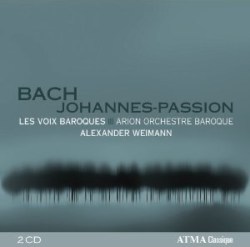
Recordings of Bach’s St. John Passion have accumulated over the decades to the point where any new one must justify its existence — and this one, conducted by Alexander Weimann, does so partially but not entirely.
Weimann opts for the 1724 version, reconstructed with help from the 1749 sources, which is the standard scholarly choice and the right one. He uses three voices per part in the tutti — the opening and closing choruses, the turbae, the chorales — a lean, historically informed approach that suits the work’s taut dramatic energy. Curiously, though, the B section of the closing chorus “Ruht wohl” is handed to four soloists. Why? I’m not sure the disc makes a convincing case for that decision.
The turbae are something else. Electrifying, really — the crowd’s bloodlust in “Kreuzige ihn” snaps into focus with a ferocity that larger forces often blur. These choruses carry the interpretation’s dramatic momentum, and Weimann keeps the connective tissue tight, pushing through recitatives, arias, and choruses with minimal breathing room. The effect is theatrical, almost cinematic. You feel the trial’s terrible velocity.
Which makes the opening chorus — “Herr, unser Herrscher” — all the more disappointing. Weimann takes it too fast. That grinding, inexorable weight in the bass line, the sense of a sovereign narrative being set in motion, gets swallowed by the pace. This matters enormously. The opening chorus isn’t just a prologue; it frames Jesus as the one who, paradoxically, commands his own Passion. Lose that gravity and something essential drains away from everything that follows.
The chorales fare better than one might expect. Far better, actually. Stress patterns are observed, text declamation is precise, articulation clean without being fussy. Weimann, German-born and steeped in this language at a cellular level, clearly rehearsed the diction with care — and it shows in the soloists too, most of whom handle their German with more idiomatic ease than their native tongues might suggest.
Jan Kobow is the Evangelist, and he’s been living with this role long enough that it feels inhabited rather than performed. His narration moves like speech — shaped, inflected, emotionally alive without the melodrama that ruins lesser accounts. The first part’s recitatives sit a touch slow for my taste, but that’s clearly Weimann’s tempo, not a failure of commitment. Stephan MacLeod sings Jesus with authority and impeccable German. His voice doesn’t especially move me — a certain tremolo surfaces at inopportune moments — and “Betrachte meine Seel” wants a darker, more searching color. But the performance is honorable.
The arias are uneven. Shannon Mercer’s “Ich folge dir gleichfalls” is the high point — her articulation precise, her dynamic shading genuinely expressive, the whole thing alive in a way that the other soloists don’t quite match. Agnes Zsigovics brings a lovely instrument to her contributions, though the review material I have runs out before the full picture emerges.
A mixed outcome, then — but one with real strengths. The turbae alone are worth hearing.