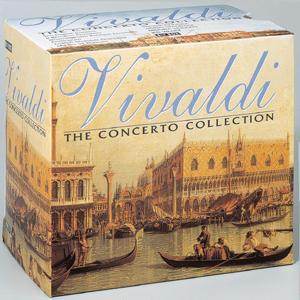
THE CONCERTO COLLECTION
Antonio Vivaldi (1678-1741)
various Artists
BRILLIANT CLASSICS STEMRA 99415
VIVALDI: The Concerto Collection
Various Artists
Brilliant Classics 99415 [8 CDs: 67’06”, 68’31”, 50’43”, 54’32”, 53’36”, 71’13”, 73’43”, 51’39”]
Brilliant Classics has done what it does best—assembled a sprawling anthology of Vivaldi concertos from various sources, some defunct, others still very much in business. The recordings span nearly two decades, offering a fascinating cross-section of period performance practice from the late 1970s through the mid-1990s. What we get, in effect, is a documentary record of how attitudes toward baroque performance evolved during those years, from the relatively circumspect English Concert to the take-no-prisoners revisionism of Il Giardino Armonico.
The question, of course, is who needs eight CDs of Vivaldi concertos? The Red Priest’s fecundity was both blessing and curse. Stravinsky’s quip—that Vivaldi wrote the same concerto 500 times—wasn’t entirely fair, but it wasn’t entirely wrong either. The real variable here is inspiration, and Vivaldi’s inspiration was notoriously erratic. Alongside genuine masterworks you’ll find pieces so routine you wonder if he was thinking about lunch while he wrote them.
The Four Seasons and Beyond
The set opens with Trevor Pinnock’s English Concert in Il Cimento dell’Armonia e dell’Invenzione, Op. 8, recorded for CRD in 1978. This was early days for the period instrument movement, yet the playing already sounds remarkably assured. Simon Standage’s Four Seasons strikes an ideal balance—swift but never hustled, expressive without crossing into anachronistic romanticism. The proto-romantic slow movements sing sweetly; the faster ones have that springy-footed vitality that makes you remember why this music conquered Europe.
But here’s what matters more: the other eight concertos of Op. 8 stand up splendidly alongside the ubiquitous four. If you only know The Four Seasons, you might find No. 5 a bit pallid and start to worry. Don’t. The remaining works are inventive and characterful, particularly the relatively extended No. 11, which gives Standage ample opportunity to display his baroque violin’s capabilities. The continuo player switches judiciously between harpsichord and a small baroque organ—a delightful touch in the Largo of No. 12.
The two supplementary concertos present problems. In the D major flute concerto (RV 429), Stephen Preston’s traverso is tuned considerably flatter than the strings in the opening movements. It has a certain rustic charm at first, but by the Largo I found myself trying to listen to flute and strings with separate ears, attempting to hear them as independent sonic events. Mercifully, someone noticed—the finale finds the flute properly tuned. Were the sessions really so time-pressed they couldn’t redo two movements?
The B minor cello concerto (RV 424) suffers from Anthony Pleeth’s ungenerous tone and effortful execution on his period instrument. Here, I’m afraid, is your original-instrument man as we learned to hate him when he first hit the scene—all scrape and struggle, the antithesis of Standage’s polished eloquence. The contrast rather points up how much progress baroque cellists have made since 1978.
Still, these are quibbles when you’re getting a virtually flawless Op. 8, beautifully recorded and intelligently played. The pitch, by the way, is almost a semitone below modern concert pitch—something you’ll notice if you have perfect pitch or try to play along.
Radical Rethinking
Il Giardino Armonico’s 1988 disc of the Concerti da camera (licensed from Nuova Era) represents the opposite pole from the English Concert’s approach. These chamber concertos—works for small instrumental groups without the solo/ripieno contrast of the full concerto—get performances that seem designed to wipe clean the slate of all previous assumptions.
Everything here is extreme. Attacks are brittle, strings rasp, oboes and bassoons cluck, accompanying lines are relentlessly staccato. Anything resembling expressive cantabile is strictly outlawed. Tempi are as fast as humanly feasible whether the marking says Allegro, Largo, or Presto. The recorder’s intonation difficulties in the upper register are treated as piquant tone-color rather than problems to be overcome. The different timbres of the instruments are kept in sharp relief rather than blended.
It sounds perfectly ghastly, doesn’t it? Except it isn’t. The performances are carried off with such flair and conviction that you begin to wonder whether this, rather than the English Concert’s more traditional manner, might actually be closer to what Vivaldi intended. Certainly both can’t be right. To ears trained in the 1960s and ‘70s, when period performance was just beginning, this sounds less like Vivaldi than a mid-twentieth-century pastiche by Casella or Jean Françaix—yes, it’s that champagne-sparkling, that cheekily modern.
Try the final two movements of RV 98. The Largo shows how fascinatingly perverse these performances can be at their best; the Presto has the recorder’s scales shooting up like rockets. Since we don’t know which approach is “right,” you’ll get considerable food for thought bouncing between these discs and the English Concert’s.
Swedish Caution
Dan Laurin and the Drottningholm Baroque Ensemble occupy middle ground between the English Concert’s traditionalism and Il Giardino Armonico’s revisionism, and sometimes seem neither one thing nor the other. The recorder concertos (BIS, 1991) are closely miked—Laurin’s breaths before fast movements arrive with “I’ll-huff-and-I’ll-puff-and-I’ll-blow-your-house-down” intensity. The harpsichord is aggressively brilliant, the recorder dominates even the busiest string textures.
I found the answer was to listen at much lower volume than usual, creating a more concert-hall-like perspective. Part of the trouble is that Vivaldi hasn’t always provided his most imaginative material in these works. Your mind wanders, and you start hunting for reading shortcomings to explain why. Perhaps that’s unfair—when Vivaldi is on form, Drottningholm responds. The long Largo of