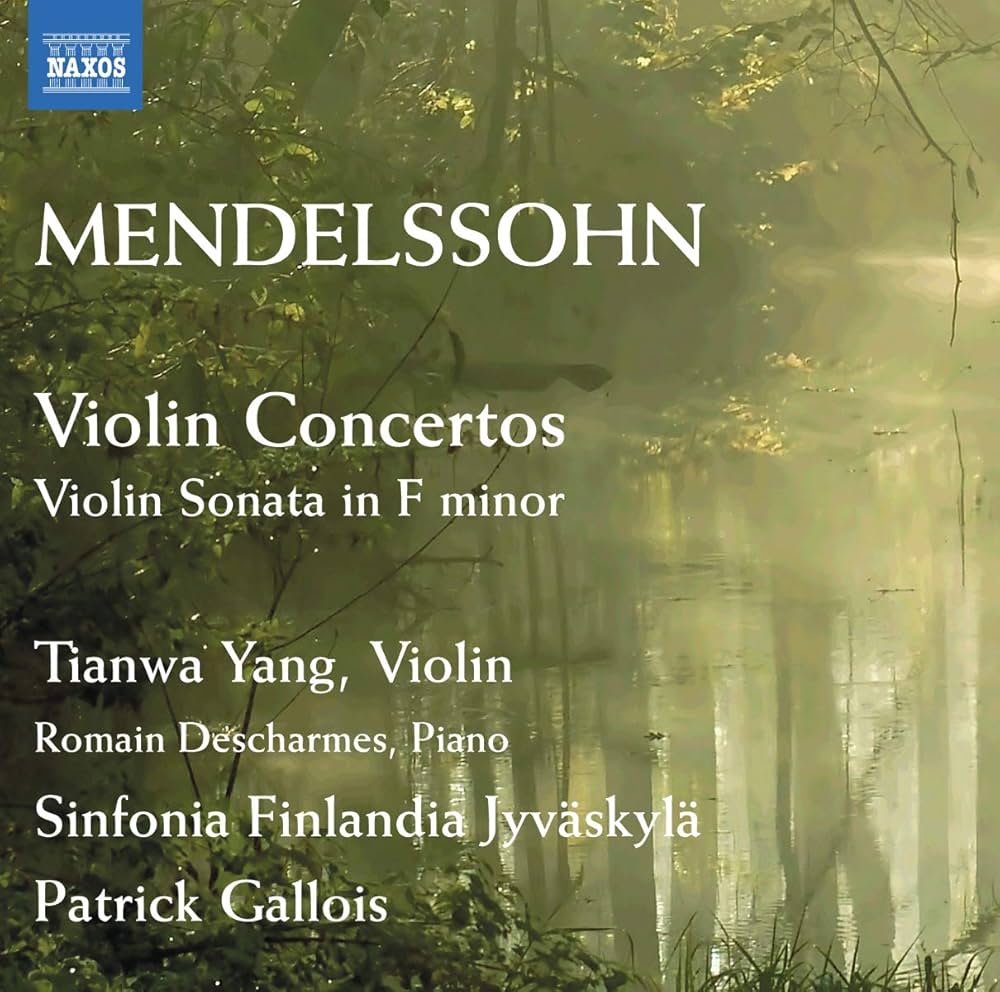
Mendelssohn: Violin Concerto in E Minor, op. 64; Violin Concerto in D Minor; Violin Sonata in F Minor, op. 4
Tianwa Yang, violin; Sinfonia Finlandia; Patrick Gallois, conductor. Romain Descharmes, piano.
Naxos 8.572662.—There are works so thoroughly embedded in the repertoire that every new recording arrives already shadowed—shadowed by memory, by expectation, by the ghosts of players who made the piece feel inevitable. The Violin Concerto in E Minor, op. 64, is one of those. You hear Heifetz’s 1959 account and something closes in your chest. The temperature drops. That’s not nostalgia; that’s a standard.
So where does Tianwa Yang stand?
Quite well, actually—better than quite well in places. The Chinese violinist, still in her mid-twenties at the time of this release, brings to the E Minor concerto a tone that’s lean without being thin, focused without the laser-cold precision that can make technically immaculate playing feel somehow airless. Her opening statement of the first-movement theme has real urgency to it, the bow pressure slightly increased at the phrase peaks in a way that feels instinctive rather than calculated. Patrick Gallois and the Sinfonia Finlandia are with her, mostly—the orchestra a little recessed in the Naxos acoustic, the strings occasionally wanting more body in their inner voices.
The cadenza—Mendelssohn’s own, placed so audaciously between development and recapitulation rather than at the end where audiences expected it—Yang takes with commendable flexibility. No rush. The ascending arpeggios have genuine shape, not just velocity.
What’s missing, if anything, is the sense that this music is costing her something. Heifetz made you feel the E Minor concerto as confessional. Mutter, with Karajan on DG, found a kind of Romantic grandeur that transformed even the songful second movement into something weightier than its marking suggests. Yang’s slow movement is lovely—the tone warm and even, the phrasing natural—but it stays lovely. It doesn’t ache.
The real discovery here is the Violin Concerto in D Minor, the early concerto written when Mendelssohn was thirteen and essentially unknown until Yehudi Menuhin revived it in the 1950s. Yang plays it with evident affection and—this matters—an understanding of its stylistic context. This isn’t Romantic Mendelssohn reaching backward; it’s a brilliantly gifted child absorbing Viotti, the early Beethoven concertos, the whole late-classical violin idiom, and producing something that synthesizes rather than merely imitates. The solo writing in the first movement already shows that characteristic Mendelssohn quality: technical demands that sound effortless, fireworks that illuminate rather than merely dazzle. Yang’s intonation through the upper positions is impeccable. The finale trips along with infectious lightness.
Then there’s the Violin Sonata in F Minor, op. 4—another early work, from 1823, recorded separately in Sandhausen with pianist Romain Descharmes. The acoustic here is noticeably different, drier, more intimate, and it suits the music. Descharmes is an attentive partner, neither overshadowing Yang nor retreating into mere accompaniment. The first movement has a storminess that anticipates the mature Mendelssohn—those driving triplets in the piano part, the violin’s rhetorical silences. Yang and Descharmes find the emotional temperature together rather than negotiating it separately. That’s rarer than it should be.
A few reservations. The Sinfonia Finlandia, for all its professionalism, isn’t quite in the same league as the orchestras Mutter or Hilary Hahn command on their recordings of the op. 64. The tuttis occasionally sound a bit scrubbed rather than polished. And Gallois’s tempos in the outer movements of the E Minor concerto feel slightly careful—as if the orchestra and soloist are being courteous to each other rather than genuinely combustible.
But this is still a disc worth owning. The D Minor concerto alone justifies the purchase. Yang is a serious artist—not yet fully formed in the way that the greatest Mendelssohn interpreters are fully formed, but serious, and gifted, and already capable of moments that stop you mid-breath. At Naxos pricing, the value is self-evident.