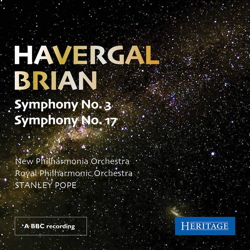
Havergal BRIAN (1876-1972)
Symphony No 3 in C-sharp minor (1931-1932) [53:53]
Symphony No 17 (1960-1961) [13:45]
Ronald Stevenson (piano), David Wilde (piano), New Philharmonia Orchestra (No 3), Royal Philharmonic Orchestra (No 17)/Stanley Pope
rec. 12 January 1974 (No 3), 23 June 1976 (Symphony No 17), BBC Maida Vale, London, UK
HERITAGE HTGCD153 [67:29]
Havergal Brian remains one of the most obstinately difficult cases in British music—a composer who lived nearly a century, wrote thirty-two symphonies, and managed to be almost completely ignored during his lifetime. This Hyperion reissue of BBC recordings from the 1970s, originally on the vanished Aries label, gives us two works separated by three decades: the sprawling Third Symphony and the terse Seventeenth. The disparity tells you something about Brian’s range, if not always about his judgment.
The Symphony No. 3 in C-sharp minor is a monster. Nearly fifty-four minutes of music that seems determined to exhaust every resource of the late-Romantic orchestra—and perhaps exhaust the listener as well. Written between 1931 and 1932, when Brian was already in his fifties and had essentially withdrawn from public musical life, it’s a work of bewildering ambition. The scoring calls for enormous forces, including two pianos (hence Stevenson and Wilde), and Brian deploys them with a kind of reckless prodigality that suggests Mahler filtered through the English choral tradition and some very peculiar harmonic sensibility all his own.
Stanley Pope and the New Philharmonia give it everything they have. You can hear the effort—this is music that doesn’t lie easily under the hands or the breath, music that seems to resist comfortable execution. The first movement alone runs over twenty minutes, a vast structure that keeps threatening to cohere into something recognizable before veering off into another thicket of counterpoint. Brian’s orchestration can be thrilling in its sheer density; it can also be opaque, muddy even, though whether that’s the composer’s intention or Pope’s inability to fully clarify the texture in a single recording session is hard to say.
The two pianos add a strange, clattering brilliance to the proceedings. Stevenson and Wilde attack their parts with conviction, but there are moments—particularly in the scherzo—where you wonder if Brian really knew what he wanted from them. Percussive reinforcement? Harmonic glue? Some kind of metallic commentary on the orchestral argument? All three, perhaps. The effect is undeniably individual, even if it’s not always successful.
What strikes me most forcibly about the Third is its refusal to compromise. This is not music designed to win friends or influence people. The slow movement has a kind of frozen, hieratic quality—those long-held wind chords over restless string figures—that puts me in mind of late Sibelius, though Brian’s harmonic language is denser, more chromatic, less willing to let silence do its work. The finale builds to a climax that should be shattering but instead feels curiously dissipated; the recording, made at Maida Vale in 1974, doesn’t quite capture the impact the score seems to demand.
The Seventeenth Symphony, by contrast, lasts barely fourteen minutes. Written when Brian was in his eighties—his creative Indian summer produced an astonishing flood of symphonies—it’s a single-movement work of considerable concentration. Gone are the sprawling paragraphs and the massive orchestral palette; the Royal Philharmonic under Pope sounds almost chamber-like in comparison. The 1976 release catches more detail, more transparency.
This is leaner music, though no less individual. Brian’s harmonic language had, if anything, grown more astringent with age, and there’s a brittleness to the Seventeenth that’s quite different from the Third’s Romantic excess. Brief motivic cells get tossed around the orchestra; there are abrupt silences, sudden dynamic shifts. It’s genuinely strange music—not avant-garde, exactly, but not comfortably tonal either. Brian had always gone his own way; by 1960 that way had become even more solitary.
Pope seems more at home here. The smaller scale suits him, and the RPO plays with real alertness. There’s still the occasional rough edge—these were BBC sessions, after all, not the product of endless retakes—but the music’s essential character comes through. Whether that character will appeal is another question. The Seventeenth has its admirers, but it’s an acquired taste, like olives or Busoni.
The transfers sound decent enough, though the age of the masters is audible in a certain thinness in the loudest passages. Hyperion has wisely jettisoned the original Aries liner notes (which apparently made extravagant claims) in favor of more sober commentary. The performances themselves have historical value—these were among the first recordings of either work—and Pope deserves credit for championing such intractable music.
But does the music itself justify the effort? The Third Symphony has moments of genuine power, even beauty, but it’s a tough sit, and I’m not convinced Brian’s architectural sense was equal to his ambitions. The Seventeenth is more successful on its own terms, but those terms are decidedly eccentric. Brian’s advocates will want this disc; those new to his music might start elsewhere—the Gothic Symphony, perhaps, if only for its sheer audacity. These are documents of a singular, stubborn imagination, admirably served by committed musicians but unlikely to convert the skeptical.