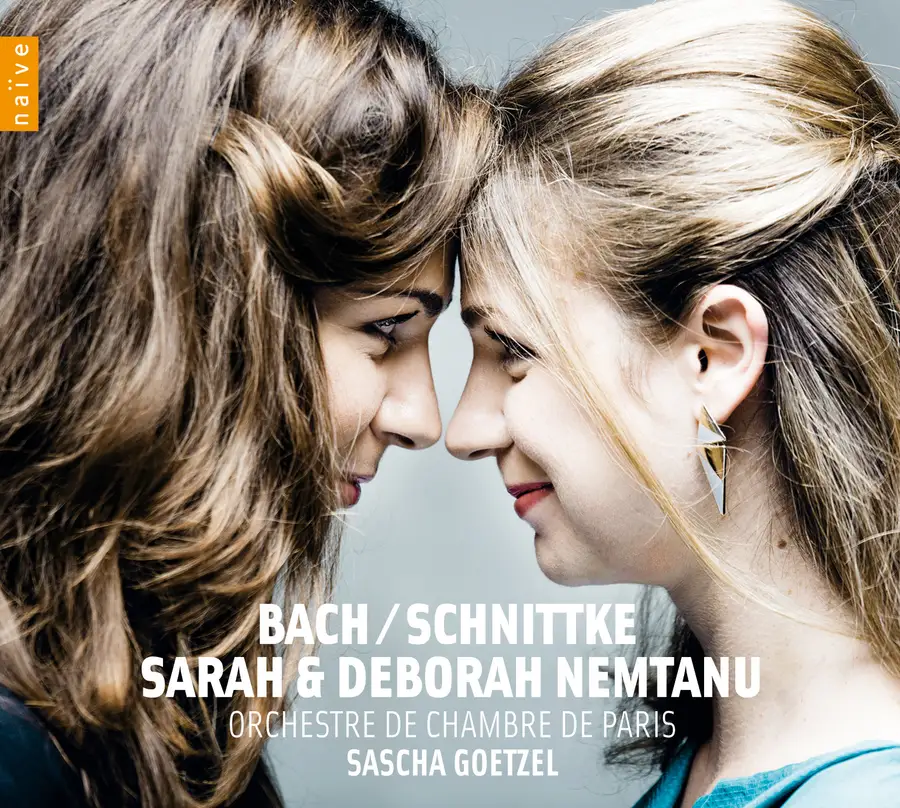
Title: Bach, Refracted Through Schnittke
Composers: Johann Sebastian Bach; Alfred Schnittke
Works: Concerto for 2 Violins in D minor, BWV 1043; Violin Concerto in E major, BWV 1042; Invention in C major, BWV 772; Invention in E major, BWV 779; Violin Concerto in A minor, BWV 1041; Concerto Grosso No. 3
Deborah Nemtanu, violin and viola; Sarah Nemtanu, violin; Orchestre de Chambre de Paris; Sascha Goetzel, conductor
Label: Naïve
Catalog Number: V 5383
Format: CD
Recorded: 2014, Salle Colonne, Paris
Release Year: 2014/2015
Duration: 67:43–68:00, depending on listing
Bach and Schnittke make one of those programs that can seem almost too clever on paper. Bach supplies the foundational forms, the familiar instrumental rhetoric, the poise and tensile balance; Schnittke arrives centuries later to disturb the surface, summon ghosts of the past, and ask what still lives inside inherited musical language. Yet this Naïve release does more than exploit an attractive concept. It turns the juxtaposition into a real conversation, and that is what gives the disc its force. The album, featuring sisters Deborah and Sarah Nemtanu with Sascha Goetzel and the Orchestre de Chambre de Paris, centers exactly on that dialogue between lineage and fracture.
The program is shrewdly laid out. Bach’s Double Concerto opens the recital with the two sisters playing together, after which they separate for the solo concertos and briefly change color again in the two Inventions, where Deborah Nemtanu takes the viola line. Only then does the disc move fully into Schnittke’s Concerto Grosso No. 3. On paper, that arc looks tidy; in practice, it proves dramatically effective. The Bach establishes an ideal of order, proportion, and lucid musical exchange, and Schnittke later receives that inheritance not with reverence alone but with tension, ambiguity, and theatrical memory.
The most immediately striking feature of the performances is the rapport between the Nemtanu sisters. Their phrasing is so closely aligned, and their sense of pulse so naturally shared, that the Bach Double Concerto often sounds less like a duel or even a dialogue than like two facets of a single musical temperament. Both players favor a focused, lean-toned sound rather than plush romantic weight, and that decision pays off throughout the Bach works. Lines are cleanly articulated, rhythms remain springy, and the music moves with a welcome sense of inevitability. There is intelligence here, certainly, but not the kind that turns self-consciously severe. The playing remains warm, alert, and alive.
The solo concertos benefit from the same approach. In the A minor Concerto, the outer movements have lift and discipline, while the central movement sings without excess. The E major receives similarly unfussy treatment, its brilliance carried by rhythmic poise rather than by display for its own sake. Goetzel and the Orchestre de Chambre de Paris are ideal partners in this repertoire because they never accompany as though standing at a polite distance from the soloists. Instead, they participate as chamber musicians on a slightly enlarged scale. That collaborative instinct is one of the disc’s chief virtues.
The two Inventions might look like modest connective tissue, but they are more than filler. By reducing scale and shifting timbre, they act as a hinge in the recital. Deborah Nemtanu’s viola adds a dusky inflection, and Bach’s concentrated counterpoint begins to feel less like a historical exhibit than like a set of living procedures that later composers might distort, remember, or reimagine. In that sense, these brief tracks do important structural work. They help the listener cross the bridge from Bach’s formal clarity to Schnittke’s more unstable world.
Still, it is Schnittke’s Concerto Grosso No. 3 that gives the disc its lingering afterlife. The work opens in a sound-world that seems to glance backward, almost ceremonially, toward Bach and the baroque concerto principle. But Schnittke being Schnittke, that doorway does not remain stable for long. The music quickly begins to shift underfoot, with echoes of earlier styles becoming material for tension, irony, estrangement, and revelation. What makes this performance so persuasive is that it does not present the work as an exercise in clever polystylism. The Nemtanu sisters and the orchestra treat it as a narrative—volatile, searching, and at times eerily beautiful.
The performance has the necessary bite for Schnittke’s sudden contrasts, but also the patience to let the work’s haunted atmosphere accumulate. Episodes unfold as commentary on one another; sonorities bloom, harden, and collapse; the solo lines sometimes emerge as guides, sometimes as survivors. The ensemble’s commitment is evident throughout, and the sense of exploration never slackens. If the Bach reveals the sisters’ technical sympathy, the Schnittke reveals their imagination. They do not simply execute the piece; they inhabit its strange internal weather.
The recorded sound serves the concept well. The engineering preserves clarity without sacrificing body. The soloists are well placed within the orchestral texture, and the overall scale remains intimate enough for the Bach while retaining sufficient weight for Schnittke’s more dramatic surges. This matters, because the recital succeeds not as a showcase of isolated tracks but as a single listening experience with a clear trajectory.
What finally makes this album more than an ingenious programming exercise is the way the two composers illuminate one another. The Bach does not merely prepare the ear for Schnittke; Schnittke sends the listener back to Bach with sharpened attention, newly aware of how much tension, invention, and latent drama already reside there. That reciprocal illumination is the recording’s deepest pleasure. The result is a recital that is thoughtful without pedantry, virtuosic without vanity, and consistently engaging from first track to last. Recommended.