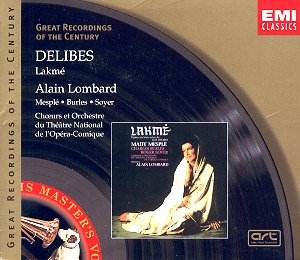
Delibes: Lakmé
Mady Mesplé, soprano; Charles Burles, tenor; Roger Soyer, bass-baritone; Orchestre et Chœurs du Théâtre National de l’Opéra-Comique; Alain Lombard, conductor.
EMI Classics 567742. Recorded 1971, Salle Wagram, Paris. 2 CDs.
There is something almost poignant about Lakmé‘s reputation—an opera known primarily for two numbers, one of them famous because British Airways thought it made a good backdrop for shots of clouds and business-class seats. The “Flower Duet” deserves better than that, and so, frankly, does the rest of the opera. Delibes was no Massenet—he lacked that composer’s theatrical cunning, his ability to make sentiment feel inevitable rather than manufactured—but he had a genuine gift for melody, for instrumental color, for the kind of languorous, shimmering texture that makes the exotic seem genuinely seductive rather than merely decorative.
The orientalism is mock, of course. Everyone knows it. The India of Lakmé is about as authentically subcontinental as a Wedgwood tea service, all sinuous pentatonic curves and tinkling bells deployed with the cheerful confidence of a composer who’d never been east of Vienna. But then Bizet’s Seville in Carmen isn’t exactly a documentary either, and we don’t hold that against him.
This 1971 EMI France recording—it took an embarrassingly long time to achieve proper international distribution—centers on Mady Mesplé, and she is both the production’s considerable strength and its stubborn limitation. Her voice is genuinely beautiful in its way: light, clean, the coloratura placed with precision, the trill reliable, the French diction a pleasure in itself after the approximate vowels one sometimes endures from non-native singers in this repertoire. When she floats a phrase in Act I—the initial encounter with Gerald, from “Viens, Mallika” through their extended scene together—there’s real delicacy, real atmosphere. She knows this music from the inside.
But Lakmé isn’t only tender. She is also passionate, desperate, finally tragic—and Mesplé’s lean, quick-vibrato instrument doesn’t easily carry those weights. The tonal palette is simply too narrow. Where Sutherland on the Decca set brings an almost alarming amplitude to the role, a sense that genuine dramatic forces are at work beneath all those cascading runs, Mesplé tends toward a single expressive register: lovely, precise, a little cool. The “Bell Song“—that extraordinary piece of vocal acrobatics in Act II—arrives with technical security intact, every high note cleanly targeted, but somehow the wildness of it, the possessed quality that the best sopranos bring to this music, doesn’t quite materialize. You admire the workmanship. You don’t shiver.
Charles Burles as Gerald is more than adequate, which is about the best one can say for most tenors in this role. His tone is pleasantly nasal in the classic Opéra-Comique fashion—think of a lighter, less heroic Gedda—and he phrases with intelligence, holds a good line, doesn’t push. Alain Vanzo on the Sutherland set is simply more assured, more elegant, more the thing entirely. But Burles doesn’t embarrass himself or the proceedings.
Roger Soyer is the real surprise. His bass-baritone is a genuinely substantial instrument—focused, resonant, capable of real dramatic weight—and his Nilakantha has menace without caricature. His brief cavatina in Act I and the later aria carry the kind of authority that makes you wish the role were larger. Soyer was in the tradition of Marcel Journet, that great French bass-baritone of the early recordings era, and you can hear it: the voice has that particular combination of darkness and clarity that French training at its best produces.
Lombard conducts with real care. The playing has focus and nuance—the orchestral palette of Lakmé is actually quite sophisticated, with its delicate woodwind writing and those characteristic shimmering string textures—and the Opéra-Comique chorus contributes vigorously and idiomatically. The Salle Wagram acoustic, warm and reasonably transparent, serves everyone well.
Is this a “Great Recording of the Century,” as EMI’s series designation grandly proclaims? No. It isn’t. The Sutherland-Bonynge set, for all its diction problems—and they are real, Sutherland’s French text sometimes dissolving into exquisite noise—offers something this recording doesn’t: genuine vocal excitement, the sense of a soprano operating near the outer limits of what the human voice can do. The Double Decca reissue is also cheaper. For those who want idiomatic French singing and care about being able to follow the text, Mesplé’s set has its legitimate claims. The Natalie Dessay disc for the same label has since superseded both in many respects. But this one retains a certain quiet dignity—like the opera itself, it’s better than its modest reputation suggests, and considerably more rewarding than an airline advertisement.