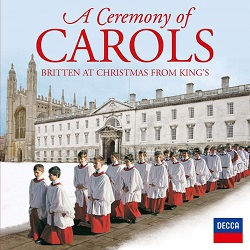
Benjamin BRITTEN (1913-1976)
A Ceremony of Carols, op.28 [22:51]
A Boy Was Born, op.3 [28:00]
Corpus Christi Carol [2:21]
A Wealden Trio: The Song of the Women [2:27]
The Sycamore Tree [1:32]
A Shepherd’s Carol [4:05]
The Holly and the Ivy (Trad. arr Britten) [4:46]
Choir of King’s College Cambridge/Stephen Cleobury
The Wilbye Consort/Peter Pears
rec. 1961-90
Presto CD
DECCA 478 5947 [66:02]
This Decca reissue brings together recordings spanning nearly three decades—a problematic assemblage that yields uneven rewards. The anthology lurches between the burnished security of King’s College under Cleobury and the altogether more fragile, more human sound-world that Peter Pears coaxed from his Wilbye Consort back in 1961.
A Ceremony of Carols receives the predictable King’s treatment: those trebles float their lines with such calculated purity that one longs for a bit of grit, something earthier. The harp (Rachel Masters, though the annotation is maddeningly vague about who plays where) sounds properly medieval in “Balulalow,” and the “Interlude” has genuine chill to it. But there’s a coolness here that keeps the listener at arm’s length. Britten wanted these carols to bite as well as bless.
The real treasure is A Boy Was Born—that astonishing opus 3, written when the composer was barely twenty. Here’s where Britten’s contrapuntal brilliance already shows itself fully formed, those grinding seconds and sevenths that would become his harmonic fingerprint. The Wireless Chorus (I assume this is the BBC Singers under another guise?) tackles the ferocious “Variation II: Herod” with proper violence. You can hear the influence of the English madrigalists, yes, but also something harder, more modern—Hindemith, perhaps, filtered through a peculiarly English sensibility.
The rendition doesn’t quite nail the work’s architecture. The final “Noel” should arrive as both culmination and benediction; here it feels slightly rushed, as if they’re eager to finish. Simon Preston’s organ adds gravitas, though the balance occasionally swamps the lower voices.
What to make of the Pears-led performances from 1961? The Wilbye Consort singing “A Wealden Trio” and “The Sycamore Tree” offers something the later, more polished recordings cannot—a sense of discovery. These singers (Hazel Holt among them) aren’t trying to pretty things up. They sing with such touching directness that you forgive the occasional wobble, the moments where intonation slides a quarter-tone sharp. This is chamber music-making in the truest sense.
“Corpus Christi Carol” appears twice—once with the Wilbye Consort, once presumably with King’s (the booklet is singularly unhelpful). The contrast is instructive. King’s gives you the notes, beautifully. Pears’s group gives you the mystery.
Britten’s arrangement of “The Holly and the Ivy” proves surprisingly conventional—he doesn’t mess much with the original. Perhaps that’s wisdom. Not every folk song needs deconstructing.
The recorded sound varies wildly, from the early sixties’ somewhat boxy acoustic to Decca’s typical late-period sheen. John Hahessy’s alto solo work (in which piece? the annotations defeat me) cuts through with affecting purity, while Kenneth Bowen’s tenor has that slightly strained quality that English church tenors often display when pushed into their upper register.
This disc serves best as a historical document rather than a first-choice recommendation. For A Ceremony of Carols, I’d still reach for the Holst Singers under Stephen Layton—more character, better pacing. The A Boy Was Born is competitive, though not revelatory. But those Wilbye Consort performances remind us that Pears understood something essential about Britten’s choral music: it needs vulnerability, not just virtuosity. The voices must sound like they’re singing to save their souls, not their reputations.
A mixed blessing, then. Worth having for completists and for anyone wanting to hear how these works sounded in Britten’s own time, when the ink was barely dry.