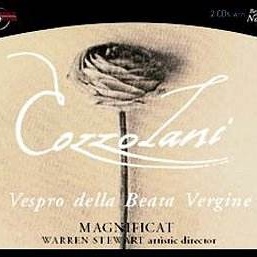
Cozzolani: Vespro della Beata Vergine: Second Vespers for the Feast of the Annunciation of the Blessed Virgin
Magnificat — Catherine Webster, Margaret Bragle, Jennifer Ellis, Jennifer Lane, Karen Clark, Ruth Escher, Suzanne Elder Wallace, Andrea Fullington, Elizabeth Anker, voices; John Dornenburg, violone; David Tayler, theorbo; Hanneke van Proosdij, organ; Warren Stewart, conductor.
Musica Omnia MO0103. Recorded 1995–2001, various locations. 2 discs + lecture disc, 142:13 + 17:28.—She never left. Chiara Margarita Cozzolani entered the convent of Santa Radagonda in Milan as a young woman and remained there until she died—composing, presumably praying, and writing music of an intensity that makes you wonder what exactly was happening behind those walls. The crowds who pressed against the church doors to hear the nuns sing weren’t drawn by piety alone. They came because the music was extraordinary.
This recording—the first in what Musica Omnia promises will be a complete survey of Cozzolani’s output—arrives as something close to a revelation. Not the breathless, press-release kind. The real kind, where you sit with something for several evenings and gradually understand that you’ve been missing a considerable composer your entire musical life.
The Vespro della Beata Vergine assembled here draws principally from the Salmi a otto voci concertati of 1650, supplemented by pieces from the earlier Concerti sacri of 1642. Warren Stewart and his ensemble Magnificat have constructed a liturgically coherent Second Vespers for the Annunciation—not a miscellany, but a complete devotional arc, from the opening “Deus in auditorium” through the two settings of the Magnificat to the final “Fidelium animae.” The architecture matters here. Cozzolani’s music accumulates meaning across its span in ways that isolated motets—however radiant—can’t fully convey.
What strikes you first is the double-choir writing. The eight-voice psalms deploy their two choruses with a spatial imagination that goes well beyond routine Venetian antiphony. In “Dixit Dominus,” the choirs don’t simply alternate—they overlap, interrupt, complete each other’s phrases mid-thought, creating a conversation that feels genuinely urgent rather than ceremonially decorative. The harmonic language is bolder than you might expect from a nun working in a closed convent: chromatic sidesteps, unexpected modal inflections, cadences that arrive from surprising directions. This is not cautious music.
The solo writing is another matter entirely. “O quam bonus“—one of the in loco antiphons substituted for the plainchant originals—gives a single voice space to breathe and expand in ways that approach the emerging aria style of midcentury opera. Cozzolani knew what was happening in the secular world, even if she couldn’t participate in it directly. The ornamentation implied in these lines, the expressive weight placed on individual syllables—“ecstatic” is not too strong a word. There’s something almost unbearably personal in this music, which is odd to say about liturgical composition, but there it is.
Stewart draws singing from his ensemble that is consistently lovely and occasionally transcendent. The blend within each choir is distinguished, and the differentiation between the two groups is just distinct enough to make the spatial drama legible. The instrumental forces are small but apt: John Dornenburg’s violone provides a warm, slightly dark foundation; David Tayler’s theorbo adds a luminous shimmer in the upper register; Hanneke van Proosdij’s organ playing is discreet and perfectly calibrated.
The recording itself—assembled across multiple sessions between 1995 and 2001, in various locations—is remarkably consistent. The acoustic is warm without being reverberant to the point of blurring, which is exactly what this music needs. You can hear the text.
A word about the third disc: Musica Omnia’s “Beyond the Notes” concept, in which scholars Warren Stewart and Robert Kendrick discuss the music with illustrative examples, is genuinely useful rather than merely promotional. Kendrick in particular, whose scholarly work on Milanese convent music is indispensable, brings real insight to the question of what it meant to compose and perform within the specific constraints—and, paradoxically, freedoms—of cloistered religious life. You won’t return to it often. But the first time through, it opens ears.
My only reservation—and it’s a real one—is that the pacing of the “Laudate Pueri” feels slightly rushed, the double-choir exchanges clipped in ways that sacrifice some of the music’s natural grandeur. And in the “Nisi Dominus,” a moment of genuine harmonic strangeness passes almost unnoticed, when it deserved to land with more weight. These are not fatal problems. But they’re there.
Still. This is music that has waited nearly four centuries for an audience, and it repays the wait handsomely. Cozzolani was not a minor figure working in isolation. She was a major composer who happened to be female, cloistered, and—until scholars like Kendrick began digging—largely forgotten. That situation is now being corrected, and this recording is central to the correction.