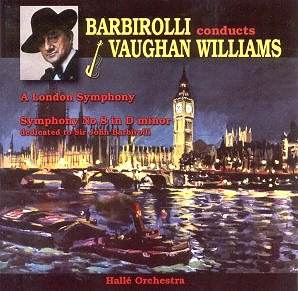
VAUGHAN WILLIAMS Symphony No. 2 A London Symphony / Symphony No. 8 (Hallé/Barbirolli)
Ralph Vaughan Williams (1872-1958)
Hallé/Sir John Barbirolli
DUTTON LABORATORIES – The Barbirolli Society CDSJB 1021 (73.33)
Barbirolli’s Vaughan Williams: Passion Unbound
These recordings hit you like a bracing North Sea wind—and if you’ve grown accustomed to the more measured Boult traversals from EMI, prepare for a jolt. Barbirolli conducts Vaughan Williams as though the composer’s heart were beating in his own chest, and the results, particularly in this exemplary Dutton restoration, make a commanding case that this music was never meant to be merely picturesque.
The London Symphony dates from June 1956, captured at Manchester’s Free Trade Hall, and what immediately strikes one is the sheer theatrical punch Barbirolli brings to the opening pages. Where Boult often adopted what one might call a pastoral stance—dignified, slightly distant—Barbirolli plunges into the score’s urban drama with almost operatic intensity. Listen to the way he drives the tempo forward at 7:03 in the first movement: it’s not reckless, but there’s an urgency, a sense of something vital at stake. The massed strings occasionally thin out at climactic moments—the hollow quality Rob Barnett notes is real enough—but the overall impression is of an orchestra completely committed to Barbirolli’s vision.
The Lento has genuine tragic weight here. Those premonitions of Dona Nobis Pacem at 8:53 emerge with startling clarity, and one realizes how much Barbirolli understood about Vaughan Williams’s spiritual architecture, the way these symphonies build toward moments of hard-won peace rather than settling into comfortable resignation.
Then there’s the Eighth Symphony, written for Barbirolli and premiered by him—and you can hear the personal connection in every bar. This 1957 recording, originally issued on Pye and later perpetuated through various incarnations (PRT’s CD, that long-lived Golden Guinea LP coupling with Bax and Butterworth), has been beautifully restored by Michael J. Dutton. The Cozart and Fine engineering—yes, the Mercury team worked on this—has that characteristic close-up perspective, instruments spotlit with almost uncomfortable intimacy. The string sound can be raw, the album flirting with saturation levels in ways that make you wonder how close they came to disaster with that old ferric oxide stock.
But what sonics! The bite, the richness, the sheer presence of the sound nearly fifty years on remains astounding. And Barbirolli uses that clarity to reveal details I’d never quite heard before. That scherzo—at 1:10, those strident woodwinds suddenly evoke Shostakovich, of all people. It shouldn’t work, this hint of Soviet irony in an English octogenarian’s symphony, but there it is. Vaughan Williams kept his ears open, kept engaging with contemporary music, and Barbirolli catches that restless intelligence.
This isn’t just a showcase for what the composer called “spiels and ‘phones“—though the variety of instrumental color is ravishing. It’s a deeply felt reading of a work that can seem merely playful in less committed hands. Barbirolli finds the poetry beneath the surface brilliance.
Michael Kennedy contributes notes, and there’s a useful RVW/Barbirolli discography. One small but telling detail: Dutton has left a generous gap between the epilogue of the Second Symphony and the opening of the Eighth. These accumulating good judgments—the care taken with pacing, with allowing music to breathe—speak volumes about a company’s values. Mission statements be damned; this is how you reveal respect for the music and the listener.
The performances make their case with overwhelming conviction. If you’ve thought of Vaughan Williams as somehow passion-neutral, as a composer of tasteful watercolors, these recordings will disabuse you of that notion. Barbirolli reminds us that there’s blood and sinew in this music, urban grit alongside pastoral beauty, genuine tragedy alongside hard-earned transcendence.
One hopes—fingers crossed—that Dutton can secure rights to Barbirolli’s Sinfonia Antartica (which he premiered, after all) and that Tuba Concerto with Philip Catelinet. The thought of those Cheltenham and Proms performances of Bax’s Fifth and Sixth with Barbirolli probably remains a collector’s fantasy, but stranger things have surfaced from dusty archives.
For now, we have these two symphonies, and they’re essential. Anyone who cares about Vaughan Williams, anyone who wants to hear what this music can do when conducted with complete conviction and no inhibitions, needs these performances. They’re not definitive—nothing ever is—but they’re indispensable.