 Cimarosa: L’italiana in Londra (libretto by Giuseppe Petrosellini)
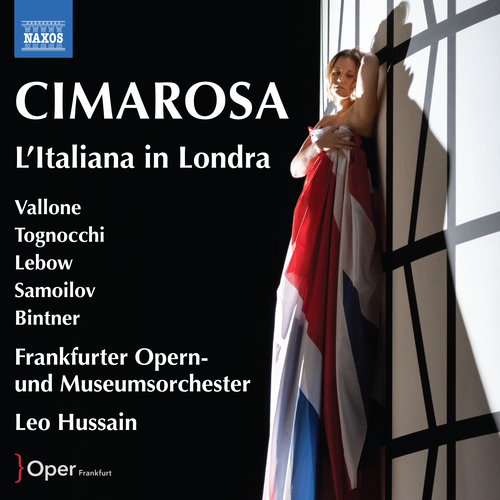
Angela Vallone (Livia), soprano; Bianca Tognocchi (Madama Brillante), soprano; Theo Lebow (Sumers), tenor; Iurii Samoilov (Milord Arespingh), baritone; Gordon Bintner (Don Polidoro), bass-baritone; Frankfurt Opera and Museum Orchestra; Leo Hussain, conductor and fortepiano
Naxos 8.660586-87 • Recorded November 2021, Oper Frankfurt • 2 CDs
Domenico Cimarosa is one of those composers whom history has treated with a particular cruelty: remembered for a single work while sixty others gather dust. Il matrimonio segreto holds the stage; everything else has been allowed to lapse. Yet L’italiana in Londra — the twelfth of his operas and his first international triumph — was, in its day, performed all over Europe. When it premiered at the Teatro Valle in Rome in 1778, audiences understood immediately that something fresh and funny had arrived. The fact that it took until Frankfurt, 2021, to give the work a proper modern staging says more about operatic conservatism than it does about the music.
And the music is delightful. Not a masterpiece — let us be honest about that — but a supremely accomplished comic intermezzo, fluent and inventive, with a gift for ensemble writing that occasionally makes you reach for the M-word. Cimarosa and his librettist Giuseppe Petrosellini set their comedy in a London hotel, where the Italian girl Livia is working as Madama Brillante’s maid-of-all-work, concealing her identity while nursing a broken heart over an English Milord who disappeared to Jamaica at his father’s insistence. Into this establishment arrive said Milord, a genial Dutch merchant named Sumers, and the gloriously foolish Neapolitan Don Polidoro, all of whom become, in various ways, entangled. The cultural stereotypes — phlegmatic Englishman, sensible Dutchman, excitable Italian, flirtatious Frenchwoman — are deployed with a wit that still functions across the centuries.
This Naxos release transfers the audio from the Frankfurt production previously issued on DVD, and it wears its theatrical origins lightly. Leo Hussain conducts with a light touch and real comic timing — the "finale"s in particular have that sense of escalating confusion that opera buffa demands but rarely achieves. He also plays the fortepiano continuo himself, adding a personal quality to the recitatives that many productions leave to a subordinate.
Angela Vallone’s Livia anchors the proceedings. Her soprano has warmth and flexibility, and she shapes the extended Act II scene — that pair of arias where Livia works through betrayal toward resolution — with genuine dramatic intelligence. The music invites comparison with Mozart’s more searching heroines, and Vallone is equal to the challenge without overreaching. The pathos of her cavatina Straniera, abbandonata registers quietly but surely.
Gordon Bintner’s Don Polidoro is the comic revelation of the set. The Canadian bass-baritone deploys his rich, even voice with an ease that makes the character’s buffoonery seem effortless. His aria Dammi la mano, o bella is a small masterpiece of comic timing, the voice swooping through Cimarosa’s wide intervals with evident relish. It is the kind of performance that makes you wish the role were twice as long.
Bianca Tognocchi brings a knowing charm to Madama Brillante — the soprano tone bright and clear, the comic instinct sure. Iurii Samoilov handles the Milord’s transformation from sullen aristocrat to ardent lover convincingly, the baritone voice carrying a natural authority. Theo Lebow’s Sumers is warm and musical, though the role gives the tenor less to do than the others.
Hussain shapes the Frankfurt Opera and Museum Orchestra into a nimble, responsive ensemble. The Sinfonia that opens the opera is taken with a spring in its step, establishing the tone with admirable economy. The high woodwind writing — and Cimarosa deploys his winds with Mozartian skill — registers clearly throughout, and the orchestral tuttis in the "finale"s build with satisfying momentum.
For anyone who knows only Il matrimonio segreto, this disc offers a genuine discovery: an earlier, slighter work that nonetheless shows the same gifts — melodic invention, a sure sense of comic pacing, and an understanding of how to make an audience laugh through purely musical means. Hussain and the Frankfurt company make as persuasive a case for the work as one is likely to encounter. The Naxos price makes the gamble negligible. Take it.