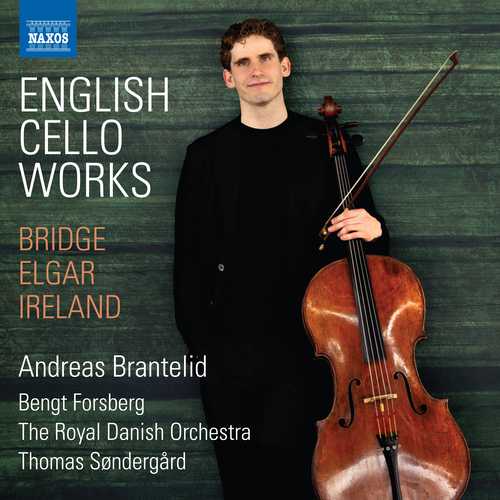
 Elgar: Cello Concerto in E minor, op. 85; Salut d’amour, op. 12 (arr. cello and piano)
Ireland: Cello Sonata in G minor
Bridge: Cello Sonata in D minor, H125
Andreas Brantelid, cello; Bengt Forsberg, piano; Royal Danish Orchestra; Thomas Søndergård, conductor
Naxos 8.573690 • Recorded [date] • 73:00
Andreas Brantelid first performed Elgar’s Cello Concerto in E minor, op. 85, as a soloist at fourteen, playing with the Royal Danish Orchestra. His father, then a member of the Opera Orchestra in Copenhagen, was in the ensemble that night. The work has remained central to Brantelid ever since, and this live Naxos recording with the Royal Danish Orchestra under Thomas Søndergård has the feeling of a long-matured return.
The program is well chosen. Bridge began his Cello Sonata in D minor in 1913 and finished it during the First World War. Elgar wrote the concerto in 1919, and Ireland’s Cello Sonata in G minor followed soon after. These works belong to roughly the same historical moment, and each, in a different way, reflects a world marked by loss and exhaustion. The connection is less formal than emotional, but it is strong enough to give the disc real unity.
The Elgar concerto is the center of the program, and Brantelid’s performance is shaped by restraint. He seems to understand the score’s nobilmente marking not as display but as bearing. The opening is grave and inward, with plenty of feeling but no excess. Throughout, Brantelid avoids the inflated rhetoric that can weigh this work down. Søndergård and the orchestra meet him on those terms, giving the performance a strongly collaborative character. This is very much a reading built on conversation between the soloist and the orchestra rather than on sheer projection. The "Adagio" is especially fine: poised, simple, and deeply felt. The "finale" has energy without forcing the issue, and the backward glance near the end lands with real poignancy. The fact that this is a live recording helps. There is a welcome immediacy in the playing, and nothing feels routine.
The Ireland sonata is one of the disc’s chief attractions. It remains underplayed, and Brantelid and Bengt Forsberg make a strong case for it. The work is tightly made and often more intricate than it first appears, with ideas returning in altered form and the piano carrying much of the structural burden. Ireland’s language here is lean and concentrated, but not without warmth. There are even moments where the rhythmic turn of phrase hints at something more modern. Forsberg is excellent throughout. He gives the piano part shape and weight without ever drawing attention away from the whole.
The Bridge sonata is divided between two emotional worlds. The first movement, begun before the war, is expansive and lyrical, with a dark Romantic cast. The second, completed later, is more unsettled and more severe. Its sharper edges and darker harmony suggest a changed sensibility. Brantelid plays both movements with clarity and discipline, letting Bridge’s contrasts emerge naturally.
The disc ends with an arrangement of Elgar’s Salut d’amour, op. 12, for cello and piano. It is a modest but effective close.
Naxos’s sound is very good. The concerto has warmth and space, while the chamber works are closely focused without feeling dry. Forsberg’s piano is well balanced against the cello, and details register cleanly. The booklet notes are informative and useful.
The Elgar concerto has never lacked for distinguished recordings, and Jacqueline du Pré’s account with Barbirolli still holds a special place for many listeners. Brantelid is not trying to rival that performance on its own terms. His reading is more contained, more inward, and quietly persuasive. The Ireland and Bridge sonatas are also given performances of real conviction. Altogether, this is a thoughtful and rewarding release, and one well worth hearing.