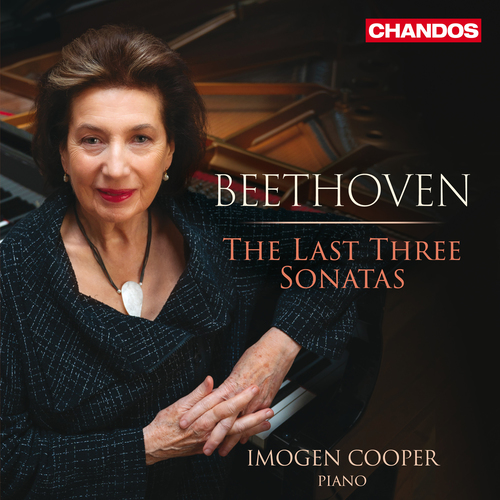
Beethoven: Piano Sonata no. 30 in E major, op. 109; Piano Sonata no. 31 in A♭ major, op. 110; Piano Sonata no. 32 in C minor, op. 111
Bartók: 4 Dirges, op. 9a, BB 58: no. 1, "Adagio"
Imogen Cooper, piano
Chandos CHAN20362 • Recorded [date] • 71:37
Imogen Cooper writes in her note for this disc that it took many years for her to perceive Beethoven’s last three sonatas as a single evolving journey. Wariness of op. 109, she says, and overawe of op. 111, kept her concentrated for a long time on op. 110 alone. She came to the outer two late — as she came, she tells us, to the Diabelli Variations — and found that arriving late had its rewards: the music presented itself with more vivid colours than it might have done had she wrestled with it in youth while still wrestling with herself. The note is a small masterpiece of self-knowledge, and it prepares you exactly for what you’re about to hear.
This is Cooper’s final recording before retiring from the concert platform and the studio. The weight of that context could easily crush a disc, turn it into an occasion rather than a performance. What saves it — what makes it something considerably more than a valediction — is that Cooper plays these sonatas not as summit statements but as acts of sustained, quiet attention. The BBC Music Magazine called it the record of a meditation. That description earns its keep.
Op. 109 sets the tone immediately. That opening Vivace ma non troppo, with its deceptive simplicity and its sudden plunge into "Adagio" espressivo, can sound arbitrary in lesser hands — a structural puzzle rather than a felt experience. Cooper makes the transitions breathe naturally, the two tempos existing not in opposition but in dialogue. The long "finale", marked Gesangvoll, mit innigster Empfindung — “songful, with the most heartfelt feeling” — unfolds its six variations with a patience that never slides into stasis. Cooper trusts the music’s own momentum. The variations accumulate feeling rather than demonstrating technique, and the return of the theme at the close has a quality of arrival that is genuinely moving.
Op. 110 has long been her home territory, and it shows. The first movement’s Moderato cantabile molto espressivo is playing of real interior warmth — the tone singing without sentimentality, the inner voices carefully weighted but never labored. The "Scherzo" ("Allegro" molto) crackles with life. But it is the "finale" that justifies everything: that extraordinary sequence of "Adagio", fugue, a second "Adagio" in which the fugue subject reappears inverted and exhausted, and then the gradual, inexorable recovery that culminates in one of Beethoven’s most radiant conclusions. Cooper manages the emotional architecture of this movement with complete conviction. The darkness is genuinely dark; the emergence into light feels genuinely earned.
Op. 111 — two movements, nothing more, the last word Beethoven wrote for solo piano — presents the ultimate challenge. The first movement’s Maestoso introduction and the subsequent "Allegro" con brio ed appassionato must contain multitudes of violence and sorrow without tipping into bombast. Cooper’s first movement is tautly controlled, the rhythmic energy fierce but never hectoring. Then comes the Arietta. Nearly nineteen minutes of variations on a simple, hymn-like theme — variations that move through jazz-like syncopations, trills that seem to dissolve the instrument’s physical limitations, and finally a stillness that many pianists simply cannot find. Cooper finds it. The closing pages of op. 111 here have exactly the quality she describes in her note: the sense of having wondered and wandered in heavenly heights, and then, at last, the quiet C major chord that ends not just this sonata but all thirty-two. No fermata. Just silence.
The Bartók Dirge that closes the disc — the first of the 4 Dirges, op. 9a — serves as a coda of sorts: spare, austere, inhabiting a different grief from Beethoven’s transcendence but not unrelated to it. It is a thoughtful and slightly unexpected choice, and it works.
Chandos has captured the piano sound with clarity and warmth. There is air around the instrument, a sense of acoustic space that lets the quietest pianissimos register without straining. The recording does justice to the full dynamic range Cooper commands, from the almost inaudible to the fortissimo passages in op. 111’s first movement that must have rattled the walls of whatever hall this was recorded in.
The competition for these sonatas is fierce and distinguished: Brendel’s multiple traversals, Pollini’s austere authority, Goode’s scrupulous intelligence, Schiff’s tireless advocacy. Cooper does not displace any of them. But she adds something that is distinctly her own — a quality of earned wisdom, of music understood from the inside after decades of living with it, that makes this disc essential for anyone who cares about this repertoire. BBC Music Magazine gave it five stars and their Recording of the Month. The judgment is sound.