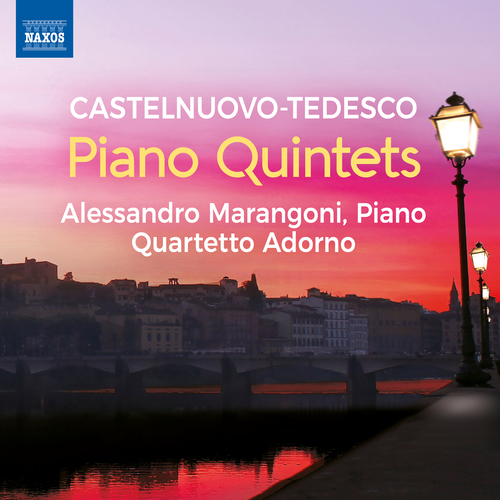
Castelnuovo-Tedesco: Piano Quintet no. 1 in F major, op. 69; Piano Quintet no. 2, op. 155, “Memories of the Tuscan Countryside”
Alessandro Marangoni, piano; Quartetto Adorno (Edoardo Zosi, Liù Silvia Pellicciari, Benedetta Bucci, Maria Salvatori)
Naxos 8.574692 • Recorded [date] • [duration]
Mario Castelnuovo-Tedesco leads a double life in the musical imagination — when he is remembered at all. There is the Florentine composer of the 1920s and 30s, celebrated across Europe, a name at the festivals of the International Society for Contemporary Music, a figure whom Toscanini and Segovia counted as a friend. And then there is the Hollywood composer, one of the émigré musicians who fled fascism and landed at MGM, scoring Gaslight and And Then There Were None and some two hundred other films while John Williams and Henry Mancini sat in the room taking notes. The two Castelnuovo-Tedescos are rarely reconciled in the standard narratives. This Naxos disc, pairing the two piano quintets that bookend his career as a chamber composer, offers a chance to hear them as a single, continuous artistic intelligence.
The Piano Quintet no. 1 in F major, op. 69, was composed in 1932, the year Castelnuovo-Tedesco met Segovia at the Venice festival of the ISCM. He considered it the finest of his chamber works from that period, and it is not difficult to hear why. The opening movement — Lento e sognante leading into Vivo e appassionato — announces a composer of real gifts: melodic invention that never turns obvious, contrapuntal writing of genuine richness, and a Romantic candor that sits somewhere between Brahms and the Italian lyricism of his teacher Pizzetti. The “dreaming” introduction is genuinely atmospheric, its string sonorities hovering with a quality of suspended time. When the Vivo arrives, the energy is not merely pasted on — it feels like the release of something the slow music had been holding in reserve.
The brief "Andante" is one of those slow movements that trusts simplicity: a singing violin line over quietly pulsing strings and piano, more elegy than argument. The "Scherzo" — Leggero e danzante — has real wit, the rhythmic lightness suggesting the folk-dance energy that surfaces periodically in Italian chamber music of the period. The "finale", Vivo e impetuoso, drives hard and arrives with satisfying inevitability. This is a well-made work that knows what it wants to be and achieves it without strain.
Twenty years separate the two quintets, and those years contain everything: the racial laws, the flight from Italy, the contract with MGM, the long twilight of studio work, the evenings composing concert music while the day job paid the bills. The Piano Quintet no. 2, op. 155, subtitled “Memories of the Tuscan Countryside” and composed in 1951, is an act of memory across an ocean. Its four movements bear programmatic titles — Le Colline (The Hills), I Cipressi (The Cypresses), Processione nel Mese di Maria (Procession in the Month of Mary), La Mietitura (The Harvest) — and the composer’s longing for a landscape he had been forced to leave permeates every bar. This is not the sentimentality of the merely homesick but the grief of someone who understands that what he is remembering no longer fully exists.
The opening Sereno e scorrevole movement establishes the pastoral world with deceptive ease — the lines flowing with a naturalness that conceals their craft. But it is the second movement, I Cipressi, that stops one cold. Nearly twelve minutes of Lento e grave, the cypresses of the Tuscan landscape translated into a musical meditation that has real depth. The harmonies darken, the piano writing becomes more searching, and one hears — unmistakably — a composer working through something personal. The third movement’s processional simplicity provides contrast, its Allegretto innocente moving like a village ceremony glimpsed from a distance. The "finale", La Mietitura, recovers the rhythmic energy of the first quintet’s closing movement, the harvest rhythm driving toward a conclusion that feels hard-won.
Alessandro Marangoni has been Naxos’s principal Castelnuovo-Tedesco advocate, and his credentials here are evident from the first bars. He understands that this music requires both technical fluency and a certain tonal warmth — the lean, percussive approach that suits some twentieth-century piano quintets would drain these works of their lifeblood. The Quartetto Adorno, whose complete string quartets for Naxos have already earned critical recognition, prove equally well-suited. Their tone is full without being heavy, their ensemble playing responsive without sacrificing individual voice. In the second quintet’s Cipressi, the string balance is particularly fine — each instrument contributing to the texture without crowding the others.
There is an existing recording of the first quintet on CPO — Massimo Giuseppe Bianchi with the Aron Quartett — which gives a somewhat leaner, more astringent account. The Marangoni/Adorno reading is warmer, more explicitly Romantic in its leanings, and for this music that seems the right instinct. The second quintet, to this reviewer’s knowledge, receives its first commercial recording here, which makes the disc doubly valuable.
Castelnuovo-Tedesco deserves better than his current near-invisibility in the concert hall. These quintets — particularly the second, with its hard-earned nostalgia — make that case with quiet eloquence. At Naxos pricing, this disc asks very little in exchange for what it offers.