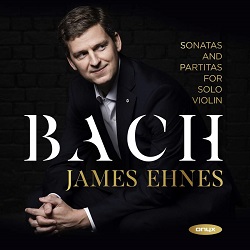
Johann Sebastian BACH (1685-1750)
Sonatas and Partitas for Solo Violin
James Ehnes (violin)
Sonata No 1 in G minor BWV 1001 [16:39]
Partita No 1 in B minor BWV 1002 [28:36]
Sonata No 2 in A minor BWV 1003 [24:20]
Partita No 2 in D minor BWV 1004 [21:18]
Sonata No 3 in C BWV 1005 [23:32]
Partita No 3 in E BWV 1006 [17:01]
rec. June 2020, Ellenton, USA
ONYX 4228 [69:43 + 72:00]
James Ehnes first recorded Bach’s six works for solo violin in 2001, when he was still in his twenties. That set earned considerable praise—and why not? The technical command was formidable, the musicianship serious and searching. But these pieces have a way of demanding return visits. They’re not so much conquered as continually reconsidered.
Twenty years on, Ehnes has gone back. Recorded in June 2020 in his living room in Ellenton, Florida—“in the depths of the night,” we’re told, to minimize extraneous noise—this new traversal arrives with the weight of two decades’ additional experience. And it shows, though not always in the ways one might expect.
The sound itself is immediately striking: close, intimate, almost uncomfortably so. You hear everything—the slight catch of the bow on the string, the tiniest shift of weight, the whisper of fingers moving along the fingerboard. Whether this appeals will depend on your tolerance for such proximity. I found myself almost unnerved by it at first, then gradually drawn into the peculiar intensity it creates. There’s nowhere to hide in this acoustic, and Ehnes doesn’t try.
The opening Adagio of the G minor Sonata sets out the interpretive terrain. Ehnes takes it at a genuinely slow tempo—no rushing through Bach’s elaborate ornamentation—and the double-stops ring with a burnished warmth that suggests he’s using gut strings, though I believe he’s actually on modern setup. The articulation is clean without being overly detached; he finds a middle ground between Baroque purists and unabashed Romantic approaches that works on its own terms. What strikes me most is the sense of architectural proportion. Each movement relates to the others with careful attention to long-range pacing.
In the fugues—those notoriously difficult movements that require a violinist to suggest multiple voices on a single-line instrument—Ehnes shows real mastery of what I’d call “implied polyphony.” The A minor fugue from the Second Sonata emerges with exceptional clarity; you can follow the subject through its peregrinations without losing track of the counterpoint swirling around it. He uses subtle dynamic inflections and minute variations in vibrato to distinguish the voices, a mastery that feels organic rather than calculated.
But here’s where things get complicated.
For all the technical accomplishment and musical intelligence on display, I occasionally found myself wanting more—more risk, more willingness to push into uncomfortable territory. The famous Chaconne from the D minor Partita, that monument of Western music that Brahms said contained “a whole world of the deepest thoughts and most authoritative feelings,” receives a reading that is beautifully played and carefully structured. Ehnes traces the variations with admirable clarity, building to the major-mode section with genuine warmth before returning to D minor with appropriate gravity. Yet somehow the cumulative impact falls just short of devastating. Perhaps it’s the very proximity of the album, which makes it difficult to achieve the kind of spacious resonance the piece seems to demand. Or perhaps Ehnes is simply too controlled, too reluctant to let the music fray at the edges.
The Third Partita in E major—that most outgoing and extroverted of the six works—fares better. Here Ehnes’s classical restraint serves the music well. The “Preludio” bounces along with infectious energy, and the famous “Gavotte en Rondeau” (later arranged by everyone from Rachmaninoff to Segovia) emerges with crystalline elegance. He doesn’t sentimentalize it, doesn’t linger over its charm. Just plays it straight, and that’s enough.
The C major Sonata, longest and in some ways most demanding of the three sonatas, receives what may be the finest rendition on the set. That massive opening movement, with its relentless sixteenth notes spinning out over nearly five minutes, maintains remarkable tension throughout. Ehnes varies his articulation subtly—sometimes more legato, sometimes with a slight detachment—to create a sense of organic development. The fugue that follows, Bach at his most intellectually rigorous, unfolds with the kind of patient inevitability that marks a mature player who trusts the composer’s architecture.
I keep returning to that question of maturity. These are not the readings of a young virtuoso out to prove something. Ehnes has nothing left to prove, technically speaking. What we get instead is thoughtful, carefully considered Bach—sometimes perhaps too carefully considered. The B minor Partita, for instance, strikes me as slightly underplayed. Those dance movements want more character, more willingness to lean into the rustic energy that underlies Bach’s courtly formality.
The recorded sound, as I mentioned, will be divisive. I’ve grown accustomed to it over repeated hearings, even come to appreciate its unflinching honesty. But it’s worth noting that this isn’t the warm, church-acoustic sound of some classic recordings. It’s more like eavesdropping on a private musical meditation—which, given the circumstances of the recording, is essentially what it is.
Where does this leave us in the discography of these inexhaustible works? Ehnes’s new recording stands as a worthy achievement, the product of serious artistry and deep engagement with the music. It’s technically superb—one expects nothing less from this violinist—and musically intelligent throughout. If it doesn’t quite reach the revelatory heights of the greatest recordings (I still return to Sigiswald Kuijken’s austere illuminations, to Isabelle Faust’s searching intensity), it nonetheless offers much to admire and ponder.
The pandemic year of 2020 produced a remarkable number of solo recordings, musicians forced into isolation finding solace and purpose in works that require no collaborators. Ehnes’s Bach belongs to that moment—introspective, carefully wrought, a bit claustrophobic perhaps, but also deeply felt. It’s the work of a mature artist coming to terms once more with music that never stops asking questions.