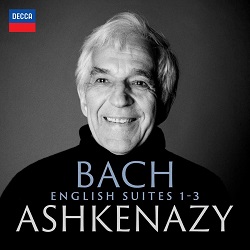
Johann Sebastian BACH (1685-1750)
English Suite No.1 in A major BWV 806 [25:09]
English Suite No.2 in A minor BWV 807 [22:36]
English Suite No.3 in G minor BWV 808 [20:42]
Vladimir Ashkenazy (piano)
rec. 5-7 April 2019, Potton Hall, Suffolk, UK
Reviewed as a digital download from a press preview
DECCA 485 2088 [68:27]Vladimir Ashkenazy at 81—still at it, still album Bach. The three English Suites here were set down in Suffolk in 2019, and they arrive with the kind of seasoned authority you’d expect from a pianist who has been thinking about this music for more than six decades. Whether that’s entirely what we need is another question.
The opening Prelude of the A major Suite unfolds with patrician calm. Ashkenazy’s tone remains consistently beautiful—rounded, substantial, never glassy or percussive even in the quickest passagework. He shapes the long arpeggiated spans with an eye toward the larger architecture, refusing to get fussy about individual figurations. This is Bach seen from a distance, perhaps, but it’s a considered distance. The left hand grounds everything with almost orchestral weight.
But there’s the rub. These performances are so determinedly pianistic—so committed to the instrument’s capacity for singing tone and dynamic shading—that they sometimes feel oddly earthbound. The Courante of BWV 806 proceeds with rhythmic squareness that borders on the stolid; where you want lift and air, you get carefully measured emphasis. Ashkenazy articulates the two-voice texture with absolute clarity, yes, but the dance has been ironed flat.
The A minor Suite fares better. Something about the key seems to focus his attention differently—the Prelude has genuine dramatic thrust, its chromatic intensifications properly unsettling. Here the weight of his approach serves the music’s introspective character. In the great Sarabande, he finds a vein of profound melancholy without resorting to exaggerated rubato or dynamic surges. Just patient unfolding, the inner voices given their due. This is the playing of someone who has lived with grief.
Then the Bourrées arrive and we’re back to that curious heaviness. These are dances, after all—stylized, elevated, but dances nonetheless. Ashkenazy’s careful evenness of touch, his refusal to articulate the upbeats with any real spring or lift, drains them of their essential character. Compare this to Perahia’s quicksilver articulation in these movements, or even Gould’s eccentric but rhythmically vital readings, and you feel the difference immediately.
The G minor Suite—the most ambitious of the three, with its French Overture opening and extended Gavotte variations—presents the greatest challenges. Ashkenazy handles the double-dotted rhythms of the opening with proper grandeur, though I missed the kind of rhetorical flourish that makes this music genuinely theatrical. The fugue that follows is admirably clear but lacks the last measure of contrapuntal tension; voices enter and depart without quite gripping each other.
Throughout, the recorded sound from Potton Hall is warm and immediate—perhaps too much so. You hear every detail of Ashkenazy’s touch, the slight emphasis he gives to melodic peaks, the way he shapes phrase endings. But you also become acutely aware of the piano’s limitations in this repertoire. The sustained notes that can’t sustain, the decay that cuts off where a harpsichord would continue ringing, the dynamic shadings that, however luminous in themselves, have nothing to do with Bach’s instrumental thinking.
This isn’t to argue for period-instrument fundamentalism. Pianists have been playing Bach magnificently for generations, finding in the modern instrument resources the composer never imagined but would surely have exploited. Yet the most convincing Bach playing on piano—Tureck at her best, Schiff, Perahia—manages to think past the instrument’s seductions, to find ways of articulating that acknowledge its anachronism while transcending it.
Ashkenazy gives us handsome, carefully considered, fundamentally conservative Bach. Nothing here will embarrass anyone; nothing will quite transport them either. The playing is too studied, too cautious in its virtues. Where is the risk, the sense of discovery? These are museum performances—respectful, well-lit, a bit airless.
For devoted Ashkenazy admirers, this will provide considerable satisfaction. The rest of us might find ourselves reaching for other versions, ones with more dance in the dance movements, more daring in the architecture. Bach deserves both respect and freedom. Here we get rather too much of the former.