MERNIER Clarinet Quintet; Les Niais de Sologne; Les Idées Heureuses; Intonazione
Benoît Mernier (born 1964)
Jean-Michel Charlier (clarinet); Quatuor Danela; Ensemble Musiques Nouvelles; Fabian Panisello (conductor); Ictus Ensemble; Georges-Elie Octors (conductor); Orchestre Philharmonique de Radio France; Michaël Schønwandt
CYPRES CYP 4613 (66:37)
Benoît Mernier emerged in the 1990s as one of those Belgian composers who seemed determined to reconcile the irreconcilable—the French spectral school’s timbral obsessions with a certain neo-Stravinskian rhythmic vitality. This disc from Cypres offers four works from that crucial decade when he was finding his voice, and the results prove more interesting than I’d anticipated.
The Clarinet Quintet opens the program. Here’s a twenty-minute span that refuses to settle into comfortable patterns, Jean-Michel Charlier’s clarinet weaving through the Quatuor Danel’s textures with a nervous energy that occasionally recalls late Messiaen—those sudden eruptions of birdsong rhetoric—but without the theological baggage. Mernier’s handling of register is acute: he knows exactly when to let the clarinet soar into its chalumeau darkness, when to pull back. The second movement (if we can call it that, given the work’s through-composed trajectory) explores multiphonics with uncommon restraint. Not the usual contemporary-music shrieking, thank heaven.
Les Niais de Sologne takes its title from Couperin, and the twelve-minute work does indeed traffic in a certain French elegance, though filtered through post-Boulezian complexity. Ensemble Musiques Nouvelles under Fabian Panisello navigates the score’s thorny counterpoint with admirable precision—listen to how the woodwinds interlock around 4’30”, a passage that could collapse into mere busyness but instead maintains crystalline clarity. The percussion writing shows real imagination, particularly in the deployment of temple blocks and wood blocks to articulate formal divisions.
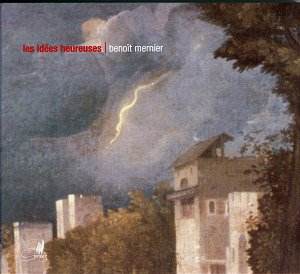
But it’s Les Idées Heureuses (another Couperin nod) that reveals Mernier at his most compelling. This twenty-two-minute canvas for the Ictus Ensemble builds from nearly inaudible whispers—sul tasto strings, muted brass breathing rather than playing—to moments of genuine orchestral heft. Georges-Elie Octors shapes the long arc with patience, understanding that Mernier’s climaxes earn their impact through accumulation rather than mere volume. Around the twelve-minute mark there’s a passage for solo violin against sustained wind chords that achieves an almost Feldman-like stillness… then explodes into rhythmic violence that actually startled me on first hearing. The transitions feel organic, not calculated.
Intonazione, performed by the Orchestre Philharmonique de Radio France under Michaël Schønwandt, strikes me as the least successful work here. It’s the earliest piece (1995), and you can hear Mernier still working out his relationship to orchestral mass. The gestures are bold enough—brass fanfares that fracture into microtonal clouds, string tremolandi that shimmer and dissolve—but the eleven-minute duration feels padded. There’s material here for a taut seven-minute statement, and the Radio France players, superb as they are, can’t quite disguise the compositional redundancies.
The recorded sound varies across these four sessions. The quintet, captured at Corroy-le-Château, has warmth and presence; you can almost smell the wood of the instruments. The Brussels sessions for Ensemble Musiques Nouvelles and Ictus sound more clinical, perhaps overly so—that Belgian studio aesthetic favoring analytical clarity over ambient bloom. The Paris album of Intonazione splits the difference, though the orchestra sits a bit too far back in the Salle Olivier Messiaen’s acoustic.
What emerges from these sixty-six minutes is a portrait of a composer who thinks in colors and rhythms simultaneously, who’s absorbed his Dutilleux and Grisey without becoming enslaved to either. Mernier’s music breathes. It doesn’t hectore or preach or demand your submission through sheer complexity. The Clarinet Quintet and Les Idées Heureuses particularly reward repeated listening—there are details I’m still discovering on the fourth or fifth pass.
This isn’t music that will set the contemporary scene ablaze, and perhaps that’s to its credit. Mernier seems content to work within a post-spectral idiom without feeling compelled to reinvent the wheel every sixteen bars. For listeners allergic to the academic avant-garde but hungry for something beyond neo-Romantic safety, this disc offers genuine rewards.