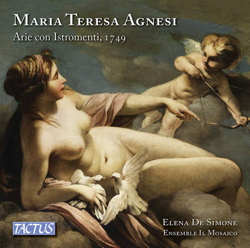
The name Agnesi usually conjures mathematics—that witch of Agnesi, the versiera—but Maria Teresa, sister to the celebrated mathematician Maria Gaetana, carved out her own considerable reputation in mid-eighteenth-century Milan. Composer, harpsichordist, singer. This Tactus release documents her 1749 collection of concert arias, and while the enterprise feels more dutiful than revelatory, there’s genuine pleasure to be had in these nine pieces.
These are arias in the full Metastasian sense: elaborate affect-paintings designed to display both compositional craft and vocal prowess. Agnesi worked within the conventions of opera seria without actually writing for the stage—at least not here. “Son confusa pastorella” opens the disc with a pastoral scenario, complete with shepherdess rhetoric and the requisite fluttering strings. The writing is fluent, sometimes even inspired, though one senses Agnesi’s imagination worked more comfortably in the instrumental parts than in the vocal lines themselves. Listen to how the strings comment and interject in “Ah non son io che parlo“—there’s real dramatic intelligence at work, a sense of theatrical timing that suggests she knew the opera house from the inside.
Elena De Simone brings a warm, slightly veiled mezzo to this repertoire. Her tone has an attractive burnish in the middle register, though the passaggi don’t always emerge with the crystalline clarity this music demands. In “Non so, con dolce moto il cor mi trema in seno” she navigates the text with sensitivity… but I wanted more bite, more edge in the coloratura. The long-breathed “Non piangete amati rai” shows her at her best: here the phrasing has genuine shape, and she finds the grief beneath the formal elegance.
Ensemble Il Mosaico provides stylish, if occasionally cautious, support. The continuo realization feels a bit thin—one misses the harmonic richness that a more imaginative harpsichordist might bring. But the string playing has warmth and polish, and in “Scherza il pastor,” the longest aria here at ten minutes, they sustain interest through some fairly conventional ground-bass variations. The recorded sound captures the acoustic of Verona’s Istituto Diocesano with appropriate resonance, though the balance occasionally favors the voice at the expense of instrumental detail.
What strikes me most about Agnesi’s writing is its curious duality. On one hand, she commands the galant vocabulary with complete authority—those thirds in the violins, the Lombardic snaps, the predictable but effective sequences. On the other, there are moments of genuine originality, particularly in her harmonic language. “Afflitta e misera,” the most substantial piece here, ventures into darker chromatic territory, with a largo section that genuinely moves. The final aria, “Alla prigione antica,” features some striking instrumental writing that wouldn’t sound out of place in one of C.P.E. Bach’s more theatrical cantatas.
The absence of texts is frankly inexcusable in 2018. We can puzzle out the general affect from the music alone, but Agnesi set these words with care—presumably Metastasio or one of his imitators—and we deserve to follow them. This isn’t some obscure dialect; it’s standard eighteenth-century Italian.
Is this essential listening? No. But it’s valuable nonetheless—valuable for what it tells us about women’s compositional activity in the Settecento, valuable as a reminder that Milan had a musical culture beyond opera seria at La Scala. Agnesi wrote with competence and occasional distinction. De Simone and Il Mosaico present her work with respect, if not quite with fire. The disc fills a gap in our knowledge of eighteenth-century Italian music, and for specialists in the period or in women composers, it will be required listening.
For the rest of us, it’s a pleasant if not indispensable addition to the catalog—solid craftsmanship from composer and performers alike, executed with taste and presented with reasonable documentary value. One emerges with respect for Agnesi’s achievement without quite being transported by it.
Richard Dyer