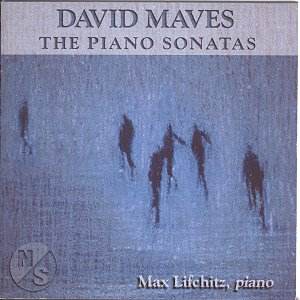
David MAVES (born 1937) The Piano Sonatas
David Maves (born 1937)
Max Lifschitz, piano
NORTH/SOUTH RECORDINGS R 1008 (75:59)
American Piano Sonatas Worth Discovering
David Maves isn’t a name that surfaces often in discussions of late twentieth-century American piano music, which may tell us more about the vagaries of reputation than about the quality of his work. This North/South release—combining sessions from 1983 and 1995—offers the four piano sonatas composed between 1973 and 1994, and they reveal a composer of considerable craft working through some of the central questions facing anyone writing for the piano in those decades. How modern to be? How traditional? And when does eclecticism become mere fence-sitting?
The Piano Sonata No. 1 announces itself as something of a structural oddity: six short sections, the first five functioning almost as preparatory studies before the “Finale” attempts to gather up the disparate threads. It’s an approach that can feel tentative—are we hearing a sonata or a suite of character pieces with aspirations? The piano writing here ventures into territory that Maves would later retreat from, with clustered sonorities and a certain angularity that suggests he’d been listening to what was happening in the 1960s and early ‘70s. Not radical by any measure—this isn’t Boulez or even Rochberg at his most astringent—but recognizably contemporary for its moment.
By 1978’s Piano Sonata No. 2, Maves had found a more confident voice. The theme and variations format, capped by that substantial finale the composer labels simply “Sonata,” invokes Beethoven’s Diabelli Variations as a model. That’s ambitious company to keep, and while Maves doesn’t match the transcendence of his predecessor (who does?), he proves a thorough understanding of how to develop material across an extended span. Max Lifschitz navigates the considerable technical demands with clarity and purpose, though I occasionally wished for more tonal bloom in the lyrical passages. The 1983 Stony Brook recording captures the piano cleanly—perhaps a bit too cleanly, with that slightly dry acoustic that characterized many university hall recordings of the era.
The Third Sonata (1993) represents what Maves himself calls “simple, straightforward Neo-classical” writing. Well, straightforward enough, though I’m not convinced “Neo-classical” hits the mark. This isn’t Stravinsky channeling Mozart, nor does it have the bright, motoric drive we associate with that aesthetic. It’s more… let’s say, post-romantic writing that’s been put through a late-century filter, shedding some of the harmonic richness but retaining the structural thinking. Modest in scale, genuinely appealing in its directness. The kind of piece that might find a place on a recital where the programmer wants something contemporary that won’t send half the audience fleeing.
Then comes the Fourth Sonata (1994), and suddenly we’re in grand romantic territory—four movements, big gestures, what Maves describes as “a gargantuan build-up for its entire length into a big ending.” The opening movement crackles with energy; Lifschitz digs into those brilliant passages with evident relish, and the 1995 Albany recording gives him a warmer, more resonant sound to work with. The theme and variations that constitute the Andante feel a bit predictable after the similar structure in the Second Sonata—one wonders if Maves relied too heavily on this particular formal device. But the nervous Scherzo provides welcome contrast, and that finale does indeed build to something substantial, even if the rhetoric occasionally outpaces the actual musical invention.
What strikes me across these four works is Maves’s essential conservatism—and I don’t mean that pejoratively. He’s a composer who clearly believes in the continuing viability of traditional forms and tonal centers, however extended. He’s not interested in the avant-garde gestures that dominated academic music during much of his composing career, nor does he embrace the minimalist alternative. Instead, he stakes out middle ground: music that’s accessible without being simplistic, contemporary without being confrontational.
Is it enough? The sonatas are well-crafted, often engaging, sometimes genuinely moving. But I’m not sure they make an essential case for themselves. They exist in a curious limbo—too modern for audiences seeking pure romantic comfort, perhaps too conservative for those wanting their contemporary music to push boundaries. Lifschitz plays with conviction throughout, and his dual role as performer and label founder (North/South Recordings) has done Maves a real service by keeping this music available.
The transfers of the earlier recordings hold up well, and the documentation is adequate if not generous. For those interested in the less-traveled byways of American piano music, this disc offers rewards. Just don’t expect revelations.