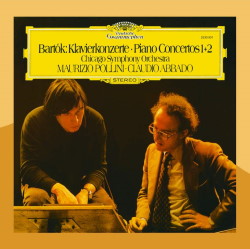
Béla BARTÓK (1881-1945)
Piano Concerto No 1 (1926) [23:25]
Piano Concerto No 2 (1930/1931) [27:35]
Two Portraits, Op 5 (1907-1911) [12:20]
Maurizio Pollini (piano)
Shlomo Mintz (violin)
Chicago Symphony Orchestra (Concertos), London Symphony Orchestra (Two Portraits)/Claudio Abbado
rec. Chicago Symphony Hall, Chicago, USA, February 1977 (Concertos), Walthamstow Town Hall, London, UK, March 1983 (Two Portraits)
Presto CD
DEUTSCHE GRAMMOPHON 477 6353 [63:33]
The two piano concertos Bartók wrote in the late twenties and early thirties remain among the most uncompromising works in the repertoire—not uncompromising in the sense of being willfully difficult or aggressive (though they’re both of those things) but uncompromising in their refusal to charm. They won’t seduce you. They state their case with the bluntness of a manifesto.
Maurizio Pollini and Claudio Abbado, captured here with the Chicago Symphony in 1977, understood this perfectly. The Piano Concerto No. 1 opens with that famous—infamous?—timpani thwack, and immediately we’re in a world where the piano functions less as a singing instrument than as an elaborate percussion machine. Pollini’s tone is hard, bright, unforgiving. Some pianists try to soften Bartók’s edges, to find lyricism where the composer deliberately withheld it. Not Pollini. His octaves in the first movement have the snap of a whip crack; his articulation in the motoric finale is so precise it’s almost frightening.
The Chicago players under Abbado match him blow for blow. Listen to the way the strings dig into those savage off-beat accents—no cushioning, no apology. The slow movement, with its eerie night-music textures, benefits from the CSO’s ability to play pianissimo without losing intensity. Those string tremolos shimmer like heat rising off asphalt.
The Second Concerto, premiered in Frankfurt in 1933 with the composer at the keyboard, shows Bartók in a slightly—only slightly—more conciliatory mood. The first movement still bristles with rhythmic complexities that can tie lesser orchestras in knots, but there’s more breathing room, more space for the piano to actually sing. Pollini finds those moments without sentimentalizing them. His phrasing in the Adagio has a sculptural quality; each gesture feels carved rather than caressed.
What strikes me most about these performances is their refusal to make Bartók safe for middle-brow consumption. The 1970s were full of recordings that tried to domesticate twentieth-century music, to sand down its rough edges. Abbado and Pollini do the opposite. They emphasize the music’s strangeness, its otherness. The finale of the Second Concerto, with its manic energy and folk-derived rhythms, sounds genuinely dangerous here—not like a clever academic exercise but like something wild that’s barely been tamed.
The Two Portraits, recorded six years later with the London Symphony and Shlomo Mintz, make for an odd but illuminating coupling. These early pieces—one “Ideal,” one “Grotesque“—show Bartók still finding his voice, still working through late-Romantic gestures toward something more personal. Mintz plays with appropriate warmth in the first portrait, though the LSO strings don’t quite match the Chicago players’ incisiveness. The grotesque second portrait, a distorted version of the same material, anticipates the sardonic humor that would surface in later works.
The recorded sound holds up remarkably well. The Chicago sessions capture the Orchestra Hall acoustic with its characteristic warmth and bloom, though the piano is placed rather forward—which suits Bartók’s conception of the instrument as a percussive equal to the orchestra rather than a lyrical counterweight. The Walthamstow disc of the Two Portraits is warmer, perhaps too warm for music that should bite a bit more.
Deutsche Grammophon’s remastering preserves the essential character of both sessions without trying to impose a false consistency. You can hear the difference in venue, in orchestra, in the six years that separate the recordings. Good.
These performances endure because they capture something essential about Bartók—his refusal to compromise, his insistence that beauty and brutality can coexist, his conviction that the piano could be reinvented as an instrument of percussive power. Pollini and Abbado were the right artists at the right time, and these recordings have lost none of their fierce integrity. Essential listening, still.