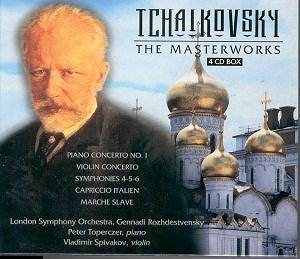
Pyotr Ilyich TCHAIKOVSKY (1840-1893)
The Masterworks
CD1
Symphony No. 4 [43.40]
Marche Slave [9.43]
CD2
Symphony No. 5 [47.00]
Capriccio Italien [16.40]
CD3
Symphony No. 6 [45.40]
Overture – The Storm [14.17]
CD4
Piano Concerto No. 1 [34.43]
Violin Concerto [35.13]
CDs 1-3
London SO/Gennadi Rozhdestvensky
CD4 – Slovak PO
Peter Toperczer (piano); cond Ladislav Slovak
Vladimir Spivakov (violin): cond Zdenek Kosler
rec dates not given. LSO recordings DDD probably late 1980s. Slovak PO ADD probably 1970s
BRILLIANT CLASSICS 99410 [4CDs: 53.18; 63.42; 59.59; 69.36] Superbudget
Rozhdestvensky’s Tchaikovsky: Solid Virtues, Missed Opportunities
Brilliant Classics offers here what amounts to a mixed blessing—three handsomely recorded symphonies under Gennadi Rozhdestvensky’s capable if somewhat earthbound direction, paired with two concertos from Slovak sources that sound exactly like what they are: serviceable Eastern European recordings from an era when orchestral precision mattered more than sonic bloom.
The symphonies, recorded with the London Symphony in what appears to be the late 1980s, benefit from demonstration-quality DDD sound. You can hear everything—perhaps too much, since Rozhdestvensky’s interpretive choices don’t always reward such scrutiny. His Fourth opens with proper weight, the brass fanfares cutting through with appropriate menace. But something’s missing. The andantino lacks lilt, as though Rozhdestvensky decided to simply march through rather than float. When we reach the scherzo, though, matters improve considerably: the pizzicato strings have genuine bite, the woodwinds dart and weave with real personality. The finale’s “Allegro con fuoco” communicates valour and high romance, yet I kept thinking of Mravinsky’s ferocious unanimity with the Leningrad Philharmonic—that steely edge, that sense of an orchestra possessed. Rozhdestvensky gives us competence where we hunger for transcendence.
His Fifth is broad, earnest, controlled to a fault. Everything buttoned down, as though emotional extremes might prove unseemly. The brass section distinguishes itself—listen to those healthy rasps at 4:10 of the opening movement—and the French horns achieve a mature, rolling roar in their ravening calls. But we could use more of Mravinsky’s near-hysteria, that sense of a composer writing from the edge of the abyss. Rozhdestvensky prefers safety.
The Pathétique avoids extremes with similar determination. The “Allegro molto vivace” wants more nerve, though the playing remains spirited enough. But the “Adagio lamentoso“—here Rozhdestvensky finally achieves something special. Not once does concentration break. Orchestral details register with fresh clarity: that metallic rattle of the horns, played impeccably down to pp, the way the divided strings seem to pull in opposite directions while somehow maintaining unanimity of purpose. This is interpretation of genuine insight.
The fillers prove predictable. Marche slave and Capriccio italien—that strange mix of Italian and French in the title—represent Tchaikovsky at his most crowd-pleasing. Rozhdestvensky conducts both with precision (those controlled string jabs at 4:03 of the Capriccio are exemplary) but little euphoria. He’s a literalist, not a seducer. The Storm, after Ostrovsky’s play, receives lively treatment. It’s not top-drawer Tchaikovsky—how could it be?—but Rozhdestvensky avoids bombast, and the piece emerges as more than mere juvenilia.
The fourth disc disappoints. These Slovak recordings, licensed from Opus and dating probably from the mid-to-late 1970s, carry vestigial hiss and coarser sonics. When the strings push into forte territory, the sound turns raw. Peter Toperczer attacks the First Piano Concerto with plenty of power, but that tremulous flute in the “Andantino semplice” won’t suit all tastes—it certainly doesn’t suit mine. The playing feels competent without being memorable.
Vladimir Spivakov’s Violin Concerto exists in another realm entirely. His tone suggests a cross between Oistrakh’s warmth and Mullova’s clarity, ringingly—almost aggressively—present in this recording. He expresses intelligence as well as emotional architecture, a rare combination. Tchaikovsky’s hurdles get despatched with style and control. The release level runs considerably higher than on the Rozhdestvensky discs, which creates balance issues if you’re listening straight through.
No liner notes. No discographical information. No dates or locations. Brilliant Classics lives up to its no-frills reputation.
For the price, you get honest, inspired performances without exaggeration or affected point-making. Rozhdestvensky’s four-square approach would satisfy in the concert hall without setting pulses racing. The symphonies offer solid virtues; Spivakov delivers something genuinely special. Shop around—at super-budget pricing, this set makes a reasonable introduction to these masterworks, though it won’t replace your first-choice recordings.