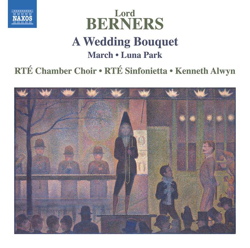
Lord BERNERS (1883-1950)
A Wedding Bouquet (1936) [33:17]
March arr. Philip Lane (c. 1945) [1:58]
Luna Park (1930) [16:35]
RTE Chamber Choir, RTE Sinfonietta/Kenneth Alwyn
rec. February 1994, Taney Parish Centre, Dublin, Ireland
NAXOS 8.555223 [52:07]
Gerald Berners—Lord Berners, properly—remains one of those figures who perplex the earnest. Too witty to be taken entirely seriously by the academy, too accomplished to be dismissed as a mere dilettante. This Naxos disc doesn’t quite resolve the paradox, but it offers pleasures enough.
A Wedding Bouquet is the substantial item here, a ballet with words (texts by Gertrude Stein, which tells you something right away) that Berners concocted for Sadler’s Wells in 1936. The piece has always struck me as deliberately, almost aggressively anti-pretentious—which is itself a kind of pretension, I suppose. Stein’s disconnected phrases float over the orchestra like cocktail chatter half-heard through a door: “They might be Italians… Webster is not at all.” The music waltzes and quicksteps through these non sequiturs with a shrug of perfect aplomb.
Kenneth Alwyn leads the RTE forces with exactly the right kind of deadpan delivery. The Sinfonietta plays cleanly, without overinflecting the jokes—and this is crucial, because Berners’ humor works best when treated straight. The little March (arranged posthumously by Philip Lane) that follows is mere aperitif, less than two minutes of genial stomping.
But Luna Park is where things get interesting.
This 1930 ballet score shows Berners at his most cosmopolitan, taking in the brash mechanistic energy of Parisian fairgrounds with an Englishman’s detachment. The orchestration glitters—xylophone, celesta, those slightly vulgar saxophone swoops that would have scandalized the Vaughan Williams set. Alwyn doesn’t quite capture the edge of hysteria that should lurk beneath the surface gaiety; his reading is a bit too comfortable, too well-mannered. I kept wanting more bite in the brass, more genuine tackiness in the fairground episodes. The RTE players sound as though they’re describing a carnival rather than experiencing one.
The release itself, made in a Dublin parish centre, has that slightly boxy acoustic that seems to afflict so many Naxos projects from this period. The strings lack bloom, the winds project well enough but without much air around them. One adjusts.
The RTE Chamber Choir in A Wedding Bouquet handles Stein’s textual puzzles with admirable clarity, though I wonder if they fully grasp the absurdist thrust of what they’re singing. “He has been told not to come in… she is very well prepared.” These phrases need to land with a certain surrealist thud, and too often they simply… don’t.
Still, there’s genuine value here for anyone curious about British music’s eccentric margins. Berners never aspired to profundity—his gods were Satie and Poulenc, not Brahms—and his best work has the evanescent charm of superb light verse. This disc captures perhaps seventy percent of what makes him worth hearing, which isn’t nothing. The performances are professional, occasionally inspired, never disastrous. For repertoire this obscure, we should probably be grateful.