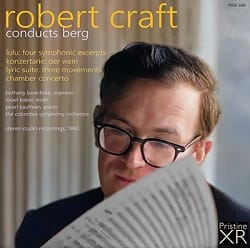
Alban BERG (1885-1935)
Four symphonic excerpts from Lulu (1934) [18:22]
Konzertarie: Der Wein (1929) [11:54]
Three movements from the Lyric Suite (1925-1926) [15:12]
Chamber Concerto for violin, piano and thirteen wind instruments (1923-1925) [29:58]
Bethany Beardslee (soprano), Israel Baker (violin), Pearl Kaufmann (piano)
The Columbia Symphony Orchestra/Robert Craft
rec. 16 December 1960, Manhattan Center, New York (excerpts from Lulu, Konzertarie), 4 April 1960, Hollywood (Lyric Suite), 8 June 1960, Hollywood (Chamber Concerto)
PRISTINE AUDIO PASC646 [75:26]
The historical value of these recordings—originally made for Columbia between 1960 and 1961, now handsomely restored by Pristine Audio—resides not merely in their documentary importance but in what they reveal about a particular moment in American engagement with the Second Viennese School. Robert Craft was then Stravinsky’s amanuensis and evangelist, yet here he turns to Berg with a clarity of purpose that sometimes eluded more temperamentally sympathetic conductors.
The Lulu Suite catches one’s attention immediately. Craft’s approach is surprisingly taut, almost neoclassical in its refusal of Romantic indulgence—which proves both strength and limitation. The Columbia Symphony (really a pickup orchestra of Los Angeles studio musicians) plays with remarkable precision, the winds especially clean in their articulation. But something is missing. Where is the perfume, the decay, the Jugendstil eroticism that clings to Berg’s final opera like cheap scent in an expensive hotel? The orchestral textures emerge with crystalline transparency, yes, but at what cost? One hears every note of the twelve-tone rows, admires the contrapuntal ingenuity, yet the music’s voluptuous surface—its sheer sensuality—remains curiously muted.
Bethany Beardslee brings her familiar virtues to Der Wein: impeccable pitch, remarkable clarity of line, intellectual command of the Baudelaire texts. Her voice, narrow but focused as a laser, cuts through the orchestral fabric without effort. Yet she sounds more concerned with getting the notes right than with inhabiting the poetry’s world-weary hedonism. The final section, “Le vin des amants,” should intoxicate; here it merely instructs. This is Berg as pedagogical exercise rather than as experience—valuable in its way, but not quite the thing itself.
The three movements from the Lyric Suite (the orchestral arrangement, not the original string quartet) fare better. Perhaps the Hollywood disc venue, or the four-month gap between sessions, made the difference. The slow movement achieves genuine pathos, the strings of the pickup orchestra managing a warmth that eluded them in the Lulu excerpts. One notices how Craft shapes the long melodic lines, allowing them to breathe while maintaining architectural control. Berg’s debt to Mahler emerges clearly—that yearning quality, the sense of something irrecoverable slipping away.
But it’s the Chamber Concerto that justifies the disc. Here Craft’s analytical approach serves the music’s needs. This is Berg at his most intellectually rigorous, the formal schemes so elaborate they threaten to collapse under their own weight. The first movement, for piano and winds alone, receives a interpretation of remarkable clarity—one can actually follow the thematic transformations, the intricate counterpoint laid bare without sounding clinical. Israel Baker’s violin, when it enters in the second movement, sounds lean and somewhat undernourished in tone, yet his intonation is flawless and his rhythmic articulation exemplary. Pearl Kaufmann at the piano proves a model of precision, though one wishes for more color, more variety of touch.
The Pristine Audio restoration deserves mention. Andrew Rose has worked small miracles with these sixty-year-old tapes, removing much of the original harshness without sacrificing detail. The sound remains dated—there’s a certain boxiness to the acoustic, a constriction in the upper frequencies—but the musical values come through clearly enough.
These recordings represent a particular aesthetic: Berg as modernist architect rather than late-Romantic voluptuary. It’s an incomplete view, perhaps even a distorted one, but not without its insights. The performances lack the last degree of emotional commitment—one misses the intensity that Pierre Boulez would bring to this repertoire, or the dark beauty of Antal Doráti’s later recordings. Yet Craft’s intellectual honesty, his refusal to fake understanding through mere expressivity, commands respect.
For students of Berg, for those interested in the history of American engagement with twelve-tone music, this reissue has considerable value. As primary listening experience, it’s more problematic. The music emerges clearly articulated but somehow undernourished, its revolutionary ardor cooled to academic respectability. One admires without quite loving—which may be precisely what Craft intended.