Polish Piano Quintets
Grazyna BACEWICZ (1909-1969) Piano Quintet no.1 (1952) [25:04]
Juliusz ZAREBSKI (1854-1885) Piano Quintet in G minor, op.34 (1885) [33:58]
Aleksander LASON (b.1951) Chamber Music no.1 Stalowowolska (1974-78) [13:29]
Lason Ensemble (Piotr Salajczyk (piano); Krzysztof Lason (violin); Agnieszka Lason (violin); Elzbieta Mrozek-Loska (viola); Stanislaw Lason (cello))
rec. Witold Lutoslawski Concert Studio, Polish Radio, Warsaw, July 2011. DDD
CD ACCORD ACD 178 [72:33]
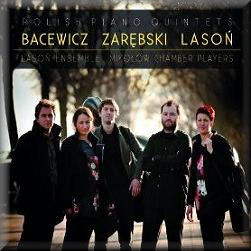 The cover says three Polish piano quintets. Well — two and a half, really. Aleksander Lason’s Chamber Music No. 1 qualifies as a piano quintet only in the loosest instrumental sense; call it a quintet with a small q. And those “Mikolów Chamber Players” listed on the front? Inside the booklet they become the Lason Ensemble. Minor deceptions, both. What’s inside the disc itself is another matter.
Grazyna Bacewicz’s Piano Quintet No. 1 gets labeled “neoclassical” in the notes — a word that’s been stretched to cover so much ground it’s nearly meaningless. This isn’t Prokofiev-dry or Stravinsky-astringent. The work sits somewhere more interesting than that: one foot planted in late Romanticism, the other testing modernist waters, and the whole thing breathing an atmosphere not entirely unlike Shostakovich’s Piano Quintet in G Minor. Which is not a complaint. Bacewicz remains scandalously undervalued — a composer whose best work rewards repeated listening in ways that most of her more celebrated contemporaries simply don’t.
But the Zarebski. That’s the reason to buy this disc.
Juliusz Zarebski’s Piano Quintet in G Minor belongs in the same conversation as Schumann’s, Brahms’s, Dvorák’s — the great nineteenth-century exemplars of the form. Genuinely. It has their structural confidence, their melodic generosity, their gift for making five instruments sound like a single breathing organism. What it also carries is something those works don’t quite have: the particular bittersweet gravity of a young man writing his final statement. Zarebski was thirty-one when tuberculosis killed him, and he knew it was coming. You can hear that knowledge in the music — not as morbid obsession, but as a kind of luminous urgency, phrases that seem to lean forward even as they look back.
The booklet notes oversell the Wagnerian and Lisztian debts — Zarebski dedicated the work to Liszt, yes, and studied with him, but the harmonic language here is far less exotic than the annotations suggest. The “wildness” is largely a fiction. This is a deeply Polish work, lyrical and elegiac, its emotional temperature closer to Chopin than to Tristan.
Martha Argerich has recorded it — of course she has — and that version has the blazing pianism you’d expect. The Lason Ensemble may not quite match her incandescence at the keyboard, but they bring something else: an idiomatic ease, a sense of this music as something lived-in rather than visited. Whether that tips the scales depends entirely on what you’re after. One caveat worth noting: CD Accord’s engineering runs a little lean, the upper strings occasionally sounding thinner than they should in a hall acoustic. It’s serviceable. Not exceptional.
Closing with a piece by the ensemble’s own namesake makes programmatic sense, even if Lason’s Chamber Music No. 1 lands like stepping from a warm room into January air. After the Zarebski’s plush harmonic world, this two-movement work — named for the Polish city where it premiered — plunges the listener into a sound world closer to Schnittke than Shostakovich: colder, more angular, the optimism of youth present but complicated. Unlike the Bacewicz, which keeps glancing backward, Lason faces forward without apology. Darkly thrilling, actually. The ensemble plays it with obvious conviction and just enough controlled ferocity.
As a program, this is an admirable act of advocacy — three composers who deserve wider hearing, given their due by musicians with real stakes in the outcome.
