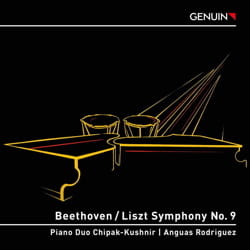
Ludwig van BEETHOVEN (1770-1827)
Symphony No 9 in D minor, Op 125 (arr. two pianos, Franz Liszt, 1851)
Piano Duo Chipak-Kushnir
Francisco Manuel Anguas Rodriguez (timpani)
rec. 26-28 February 2021, Katherinensaal, Hochschule für Musik und Theater, Rostock, Germany
GENUIN GEN21766 [65:18]
Liszt’s two-piano reduction of the Ninth Symphony—completed in 1851, when the composer was already thinking beyond the keyboard to orchestral transformation—occupies a peculiar place in the Beethoven reception history. Not quite transcription, not quite paraphrase. It’s an impossible task, really, trying to compress those immense sonorities, that cosmic architecture, into twenty fingers and eighty-eight keys. The addition of timpani here only slightly mitigates the loss.
Piano Duo Chipak-Kushnir approaches the score with admirable seriousness and formidable technical command. The first movement’s opening tremolo—those famous fifths emerging from the void—has genuine mystery in their hands, though of course the orchestral shimmer, the strings’ collective breath, can’t be replicated. What they manage instead is a kind of stark, etched clarity that has its own fascinations. The exposition repeat is taken, correctly, and the development’s contrapuntal density comes through with remarkable transparency. These are players who understand structure.
But understanding isn’t always enough.
The Scherzo works better than it has any right to. The fugal trio section, which can sound cluttered in lesser hands, emerges with real wit—Chipak and Kushnir clearly relish the interplay, the rhythmic bite. Francisco Manuel Anguas Rodriguez’s timpani contributions feel essential here, not merely decorative. He knows when to hold back. The poco ritardando before the return is perfectly judged, a moment of genuine theatrical timing.
It’s in the slow movement that the limitations become most acute. Beethoven’s Adagio molto e cantabile needs those string choirs, needs the wind choir’s hymnic responses. The two pianos—even played with all the warmth and singing tone that Chipak-Kushnir can muster, and they muster considerable warmth—sound somewhat starved, emotionally undernourished. The great modulation to D major at measure 99 lacks the luminous transformation one craves. This isn’t criticism of the reading so much as acknowledgment of what the medium can’t deliver.
The finale presents different challenges. Liszt’s arrangement of the “Ode to Joy” variations is ingenious, distributing the material with real imagination between the two instruments. The Turkish march episode has appropriate swagger. The double fugue—well, it’s there, all the notes are there, but the apocalyptic grandeur Beethoven demands? That remains stubbornly out of reach. The vocal soloists and chorus exist only as ghosts in our memory, and their absence creates a void that pianos, however brilliantly played, cannot fill.
The recording quality from Genuin is exemplary. The Katherinensaal’s warm acoustic suits this music—not too reverberant, allowing detail without dryness. Balance between the two instruments is natural, and the timpani integration never sounds gimmicky.
What we have, then, is a highly accomplished performance of an inherently compromised work. Chipak-Kushnir play with intelligence, precision, and evident devotion. They’ve mastered Liszt’s fiendish demands. But the Ninth Symphony resists domestication. It needs its forces, its massed sonorities, its sense of ritual occasion. This is music for the tribe, not the salon. As a document of Liszt’s pianistic imagination and as a showcase for two exceptional musicians working in perfect symbiosis, this disc has real value. As Beethoven’s Ninth… well, it can’t be, can it? A fascinating supplement to the discography, not a replacement for anything.