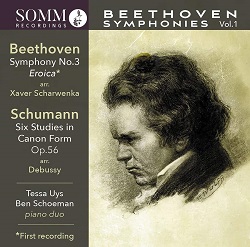
Ludwig van BEETHOVEN (1770-1827)
Symphony No. 3 in E flat major Op. 55 ‘Eroica’ (arr. piano duo, Franz Xaver Scharwenka) [51:50]
Robert SCHUMANN (1810-1856)
Sechs Stücke in kanonischer Form Op. 56 (arr. piano duo, Claude Debussy) [16:27]
Tessa Uys, Ben Schoeman (piano duo)
rec. The Menuhin Hall, Stoke d’Abernon, Surrey, UK, 24-25 August 2020
SOMM SOMMCD0637 [68:26]
This isn’t a disc for purists, and I can already hear the objections. Beethoven’s Eroica at the piano? Schumann’s canons arranged by Debussy? The very idea might seem perverse—a reduction, a compromise, something to endure when you can’t have the real thing.
But that misses the point entirely.
Piano transcriptions have their own honorable history, their own revelatory possibilities. In the nineteenth century, before recordings, before radio, this was how most people encountered symphonic literature. Liszt made it an art. The Scharwenka arrangement of the Eroica (1864) belongs to that tradition, and Tessa Uys and Ben Schoeman make an eloquent case for its continued relevance. They don’t try to simulate an orchestra—they can’t, obviously—but they do something more interesting. They expose the music’s skeletal structure, its harmonic logic, the way Beethoven builds those vast paragraphs from small motives.
The opening movement has real weight. The famous dissonance in the development lands with shocking force, maybe even more shocking than in orchestral dress because there’s nowhere to hide it, no timbral cushioning. The repeated chords that launch the exposition have genuine menace. What surprised me most was the “Marcia funebre“—I expected it to feel diminished, to lose its tragic grandeur. Instead, the starkness of two pianos brings out something almost Schubert-like in the writing, a kind of intimate devastation that the full orchestral forces can sometimes obscure with sheer sonic mass.
The scherzo works less well. Those hunting-horn effects need… well, hunting horns. The pianists do what they can, but the music feels earthbound here, deprived of its essential wildness. The finale, though—that’s another matter. The contrapuntal episodes emerge with wonderful clarity, and the final apotheosis has genuine exhilaration, even if it can’t quite match the blazing orchestral original.
Schoeman and Uys play with admirable unanimity. Their ensemble is tight, their balance carefully judged. In the quieter passages they achieve a lovely transparency—you can hear through the music, follow individual lines. The album, made at the Menuhin Hall in August 2020, captures them with warmth and clarity, though I wished for a bit more presence in the bass register during the Eroica‘s stormier moments.
The Schumann coupling proves unexpectedly fascinating. These six canons, originally for pedal piano, don’t get much attention in any form. Debussy’s arrangement for piano duo dates from his impecunious youth (1891), when he was doing hackwork for publishers. But there’s nothing hack about the results. He understood Schumann’s introspective chromaticism from the inside, and his distribution of voices between the two instruments shows real imagination.
The piece marked Innig—heartfelt, intimate—receives a particularly sensitive reading. Uys and Schoeman find the melancholy beneath Schumann’s contrapuntal ingenuity, that characteristic mixture of learned craft and Romantic yearning. The more subdued passages in the central canon have an almost hypnotic quality, the two pianos creating a kind of sonic halo around the intertwining lines. The final canon, again fugal in nature, builds to a surprisingly robust conclusion.
This isn’t essential listening, I suppose. If you want the Eroica, you’ll reach for Kleiber or Gardiner or Carlos Kleiber. But as a supplement, as an alternative perspective on familiar music, this disc offers real rewards. It’s a reminder that great music survives translation, that sometimes you discover new things by approaching from an unexpected angle. The playing has conviction, intelligence, and—in the Schumann especially—genuine poetry.
More than respectable, then. Actually rather distinguished.