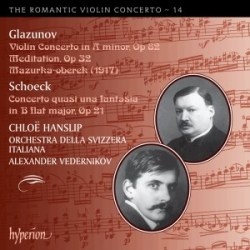
Glazunov: Violin Concerto in A Minor, op. 82; Meditation in D Major, op. 32; Mazurka-Oberek in D Major. Schoeck: Concerto quasi una fantasia, op. 21.
Chloë Hanslip, violin; Orchestra della Svizzera Italiana; Alexander Vedernikov, conductor.
Hyperion CDA68036. Recorded [dates and venue not provided]. CD.
Hyperion’s ongoing series “The Romantic Violin Concerto” has now reached its fourteenth volume, and whoever is doing the programming deserves genuine credit—not just for the obvious repertoire finds but for the occasional genuinely odd coupling. This one pairs Glazunov’s perennial Violin Concerto in A Minor with a work that almost nobody outside Switzerland seems to know exists: Othmar Schoeck’s Concerto quasi una fantasia, completed in 1912. Strange bedfellows. And yet the pairing works, or mostly works, for reasons I’ll get to.
Start with the Glazunov. The Violin Concerto in A Minor, op. 82—single movement, about twenty minutes, completed 1904—is one of those pieces that gets dismissed as salon music dressed up in evening clothes, which is unfair. Yes, it’s untroubled by modernism. Yes, the harmonic language sits comfortably in the late nineteenth century, Glazunov having apparently decided that Schoenberg’s opp. 11 and 16 simply weren’t happening. But the craftsmanship is real. The transition from the opening Moderato into the central Andante sostenuto is managed with a subtlety that rewards close listening—the key relationships aren’t quite where you expect them, and the orchestration, particularly in the woodwinds, has a shimmer that Glazunov’s detractors conveniently ignore.
Chloë Hanslip plays it beautifully. There. Said.
More precisely: her tone in the upper register has an almost vocal quality, a warmth that suits the lyrical writing without tipping into sentimentality. The opening theme sings rather than merely projects. What’s particularly impressive is her management of the long cantilena lines—she sustains them through the phrase without that slight overaccenting of the bow that you sometimes hear from younger players trying to hold the line together. The Andante sostenuto is genuinely touching. The cadenza, which Glazunov wrote himself and which isn’t exactly a showstopper by Romantic concerto standards, she handles with intelligence rather than compensatory fireworks.
The two shorter Glazunov pieces that follow—the Meditation in D Major, op. 32, and the Mazurka-Oberek in D Major—are pleasant enough. The Meditation is exactly what it says it is. The Mazurka-Oberek, which runs nearly ten minutes, is a more substantial piece than its title might suggest, drawing on Polish dance idioms with Glazunov’s characteristic harmonic elegance. Hanslip plays both with affection.
Then comes Schoeck, and this is where the disc gets genuinely interesting.
Othmar Schoeck is remembered, when he’s remembered at all, primarily as a song composer—and a very fine one, the German-speaking world’s answer to the question of what might have happened had Schubert lived into the age of Strauss and Wolf. His instrumental music is less well known, and the Concerto quasi una fantasia, op. 21—written when he was in his mid-twenties—is a revelation. Not a perfect piece. The first movement sprawls somewhat, and there are moments where the structural logic goes a little soft. But the sheer inventiveness of the thing, the way it moves between concentrated lyricism and sudden orchestral outbursts, the harmonic language that sits somewhere between Reger and early Berg without being quite like either—this is music that deserves to be heard.
The title is honest. It really is quasi una fantasia—the formal outlines are there, the three movements are in place, but the piece keeps disrupting its own architecture, following emotional logic rather than structural convention. The slow movement, marked Andante, is extraordinary: long, searching lines in the violin over an orchestral texture of considerable density, with a kind of restless harmonic motion that never quite resolves where you want it to. Hanslip finds the right quality here—introspective, a touch austere, not reaching for easy expressiveness.
The comparison that comes to mind—and it’s imperfect, as these comparisons always are—is with the Elgar concerto, not in style but in emotional temperature. Both works have that quality of speaking quietly about things that matter enormously. The Schoeck is rawer, less polished, more openly Romantic in its harmonic language while being more modern in its structural approach. A fascinating piece.
Alexander Vedernikov and the Orchestra della Svizzera Italiana provide idiomatic support throughout. The orchestra is a good one—not a major international ensemble, but capable and well prepared, and the strings in particular have a focused, singing quality that suits both composers. Vedernikov’s conducting is attentive without being fussy. The Lugano acoustic is warm and clear, the recording balance sensible.
The obvious comparison point for the Glazunov is Oscar Shumsky on Chandos (CHAN 8596), still probably the most distinguished performance in the catalog—Shumsky’s tone had a richness and authority that made everything he touched sound inevitable. Hanslip doesn’t quite have that weight of personality, that sense of a major interpretive intelligence at work. But she plays with real musicianship and considerable beauty of tone, and for the Schoeck—where there really isn’t much competition—she makes a compelling case.
This disc is worth having. The Schoeck alone justifies the purchase.