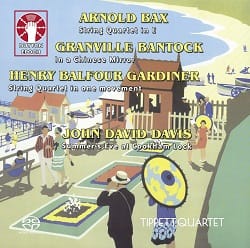
Sir Arnold BAX (1883-1953)
String Quartet in E (1903) transcr. Graham Parlett; performing ed. Martin Yeates (2020) [39:02]
Sir Granville BANTOCK (1868-1946)
In a Chinese Mirror: Quartet for Strings (1933) [17:10]
Henry Balfour GARDINER (1877-1950)
String Quartet in B-flat major (1905) [9:57]
John David DAVIS (1867-1942)
Summer’s Eve at Cookham Lock: Idyll, Op 50 (1916) [9:45]
Evan Thomas DAVIES (1878-1969)
Eos Lais (The Nightingale) (1926) [3:14]
Tippett Quartet
rec. September and November 2020, Ste George’s Headstone, Harrow
DUTTON EPOCH CDLX7389 [79:48]
The Tippett Quartet has done something rather wonderful here—rescued five string quartets from the Edwardian twilight, works that tell us more about English music’s pre-war sensibility than any amount of scholarly hand-wringing ever could. These aren’t neglected masterpieces, exactly. But they’re far better than their obscurity suggests, and in performances this committed, this technically assured, they make a compelling case for themselves.
Arnold Bax’s String Quartet in E comes to us via Graham Parlett’s transcription from a 1903 piano score, with Martin Yeates providing the performing edition. At thirty-nine minutes, it’s an astonishing sprawl—a young man’s quartet, stuffed with ideas he hasn’t quite learned to edit. The Celtic twilight hangs heavy over the slow movement, naturally, but what surprises is the rhythmic vitality of the outer sections. This isn’t the ruminative Bax of the later symphonies. The Tippett players attack the vigorous passages with real bite, though I wonder if the original might have been conceived for a slightly smaller acoustic than St George’s Headstone provides. Some of the textures blur where clarity would help.
Still, the sheer ambition impresses. Bax was twenty when he wrote this, and already the harmonic language pushes beyond Stanford and Parry into something more chromatic, more restless. The second movement’s modal inflections sound forward to Vaughan Williams—who was, remember, still finding his voice at this point—while the finale attempts a synthesis that doesn’t quite cohere but fascinates in the attempt.
Bantock’s In a Chinese Mirror (1933) couldn’t be more different. Here’s a composer in his sixties, writing with economy and purpose. The four movements sketch imagined scenes with an Orientalism that will make some listeners uncomfortable—but Bantock, whatever his limitations, had genuine feeling for exotic scales and timbres. The Tippett Quartet catches the eerie quality of “The Philosopher” movement, where harmonics and sul ponticello effects create something genuinely strange. “The Lover” borders on kitsch but never quite tumbles over. The playing here is exquisite, technically and interpretively.
Henry Balfour Gardiner’s B-flat major Quartet lasts under ten minutes and makes no pretense to profundity. It’s salon music, essentially—but salon music of considerable charm and craft. The Brahmsian textures are handled with real understanding, and the Tippett players bring out the work’s conversational quality. This is music for a summer afternoon, and none the worse for knowing its place.
The Davis and Davies pieces function as encores. John David Davis’s “Summer’s Eve at Cookham Lock” wears its English pastoral credentials on its sleeve—you can practically hear the water lapping. Evan Thomas Davies’s “Eos Lais” (The Nightingale) attempts to capture birdsong in just over three minutes. Both are miniatures, perfectly pleasant, adding variety to the program without demanding extended analysis.
The Tippett Quartet plays throughout with warmth and intelligence. Their ensemble is tight without being rigid, their intonation secure even in Bax’s more treacherous chromatic passages. I’d like a bit more tonal differentiation between voices at times—the blend is almost too good, smoothing over some of the grit these works can offer. But that’s a minor quibble. The recorded sound is spacious, perhaps excessively so for chamber music, though detail never suffers.
Dutton Epoch continues its invaluable work of documenting British music’s byways. This disc won’t revolutionize anyone’s understanding of the string quartet’s evolution, but it fills in the picture with skill and conviction. The Edwardian era produced chamber music of more character than its reputation suggests, and performances this dedicated make the argument persuasively. Recommended for anyone interested in English music’s hinterlands—and for quartet enthusiasts willing to venture beyond the standard repertoire.