CHOPIN Piano Concerto No 1 in E minor, Op 11 / Piano Concerto No 2 in F minor, Op 21 (Krystian Zimerman)
Frédéric Chopin (1810-1849)
Krystian Zimerman (piano), Los Angeles Philharmonic Orchestra, cond. Carlo Maria Giulini
DGG ORIGINALS 463 662-2 (72.26)
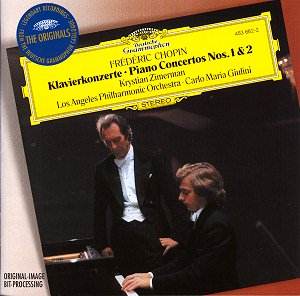
Zimerman’s Two Minds: The Chopin Concertos Then and Now
The reappearance of these recordings in DG’s Originals series presents us with something more complex than the usual archival reissue. Here we have—preserved in distinguished early digital sound—performances that once seemed like the last word on Chopin’s concertos, now shadowed (or is it illuminated?) by their own future.
I remember the furor when these discs first appeared. Zimerman was barely past his mid-twenties, yet the poise, the aristocratic bearing of his playing suggested someone twice his age. Critics reached for superlatives. Some of us wondered if we’d ever hear these works played with such crystalline perfection again. The partnership with Giulini seemed heaven-sent: the older director’s suave, old-world elegance providing a cushion of orchestral silk for Zimerman’s gleaming pianism. Listen to the way the E minor Concerto unfolds—that opening orchestral exposition has a breadth, a nobility that few conductors have brought to what is, let’s be honest, not Chopin’s most inspired orchestration. Giulini makes you forget the thinness of the scoring.
And Zimerman’s fingerwork. That legendary clarity was already fully formed. The cascades of notes in the finales emerge like pearls on a string, each one distinct yet part of an inevitable trajectory. The “Romanze” of the E minor—taken at a flowing tempo that avoids the mawkish lingering some pianists indulge in—has a singing quality that still catches the breath. He shapes the long melodic lines with an instinct for where the phrase wants to go, never forcing, never merely decorative.
But here’s the rub. Twenty years later Zimerman returned to these scores and emerged with something so radically different that it seemed to call into question everything we thought we knew. Those 1999 recordings, with their extreme dynamic contrasts, their willful rubato, their almost perverse attention to orchestral detail (he conducted his own hand-picked ensemble), divided opinion sharply. Too much, cried the majority. Self-indulgent, mannered, eccentric.
I find myself in the uncomfortable minority who was—well, not convinced entirely, but fascinated, provoked, forced to hear familiar music with fresh ears. The later Zimerman takes risks that would have seemed unthinkable in 1979. He lingers over passing harmonies, pulls the tempo back to a near-standstill in moments of lyric intensity, demands that we notice things in the orchestral writing that most conductors treat as mere padding. It’s an intensely personal, almost confessional approach—the kind of interpretation that could never be called definitive but which opens unexpected windows into the music.
Which brings us back to these Giulini collaborations. Hearing them now, after the 1999 versions, I’m struck by how—dare I say it?—safe they sound. Radiant, yes. Elegant, certainly. The technical finish is beyond reproach. But there’s a certain caution here, a reluctance to probe too deeply or disturb the surface. The young Zimerman plays with remarkable maturity, but it’s the maturity of someone who has learned the rules perfectly without yet feeling the need to question them.
Take the F minor Concerto’s “Larghetto.” In these 1979 recordings it unfolds with lovely simplicity, the nocturne-like melody spun out with exquisite taste. Nothing jars, nothing surprises. It’s Chopin as we expect him to sound—refined, melancholic, perfectly proportioned. The 1999 version, by contrast, finds shadows and sudden shafts of light we didn’t know were there, stretches time in ways that feel dangerous, even potentially self-destructive. One approach gives us Chopin the salon poet; the other reveals something more turbulent underneath.
The orchestral playing under Giulini deserves mention. The Los Angeles Philharmonic responds with uncommon sensitivity to music that orchestras often treat as mere accompaniment. The winds have character, the strings phrase with genuine care. Yet compared to Zimerman’s later Polish Festival Orchestra—where every desk player seems to have internalized the idiom—there’s an inevitable sense of these being American musicians doing their polished best with unfamiliar repertoire.
The sound quality holds up remarkably well. Early digital, yes, with that characteristic slight glassiness in the upper frequencies, but the piano is beautifully captured—close enough to hear the action, distant enough to preserve the hall ambience. The balance between soloist and orchestra is expertly judged.
So where does this leave us? If you know only these Giulini recordings, you have performances of genuine distinction, worthy of their classic status. The young Zimerman’s technical command and musical intelligence are formidable, and there’s real poetry in these interpretations—just poetry of a rather well-behaved kind.
But if you’ve heard the 1999 versions—if you’ve been challenged and perhaps unsettled by them—these earlier readings may strike you as curiously reticent. They’re the work of an artist who knows exactly what he’s doing but hasn’t yet discovered what he might dare to do. The later recordings are the work of someone who has earned the right to take liberties, who has lived with this music long enough to make it entirely his own, consequences be damned.
The ideal solution, of course, is to have both. They illuminate different facets of these enigmatic scores. But if forced to choose—and the bargain price of this Originals reissue makes it tempting—I’d suggest these represent Chopin at his most palatable rather than his most profound. They’re superb performances that no longer seem quite indispensable.