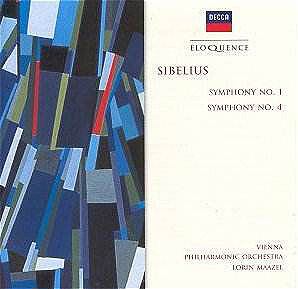
SIBELIUS Symphony No. 1 / Symphony No. 4 (Maazel)
Jean Sibelius (1865-1957)
Vienna PO/Lorin Maazel
ELOQUENCE (DECCA) 461 325-2 (69:00)
Maazel’s Sibelius: Vienna Meets the North
When Decca dispatched the Vienna Philharmonic to the Sofiensaal in 1963 to record Sibelius, eyebrows must have risen. This was an orchestra whose DNA coursed with Viennese waltz rhythms and Brucknerian piety—what business did they have in the granite-and-pine landscape of Finland’s greatest symphonist? Yet someone at Decca had an instinct, and in the young Lorin Maazel they found a maestro who could forge something unexpected from this unlikely marriage.
The First Symphony arrives with surprising diffidence—almost as if Maazel is deliberately understating the opening clarinet solo, keeping his powder dry. But once the allegro energico takes hold, all restraint vanishes. This is Tchaikovskian Sibelius with the throttle wide open, passionate to the point of vehemence. The VPO strings dig into those surging lines with a richness that threatens to become overwhelming, yet Maazel never quite loses control of the architecture. Listen to how the harp emerges near the movement’s close—Decca’s engineers spotlighting it with that characteristic early-1960s immediacy, almost too close for comfort but undeniably thrilling.
The scherzo flies. I mean genuinely flies—Maazel takes it at a clip that would have lesser orchestras scrambling for cover. The VPO’s response? Immaculate. Not a smudge, not a fumble, just diamond-hard precision at breakneck tempo. Whether this serves the music’s deeper character is another question—there’s something almost too polished about it, lacking the rough-hewn quality that Finnish orchestras bring to this score. But as pure orchestral display, it’s breathtaking.
Then the finale slashes in with barely suppressed fury. Maazel clearly means business here, driving forward with an urgency that sometimes borders on the hectoring. The VPO responds with full-throated commitment, though I occasionally wish for more space around the phrases, more room for the music to breathe between those passionate outbursts.
The Fourth Symphony inhabits another universe entirely. Written in 1910 under the shadow of throat cancer, with Sibelius confronting his own mortality, this is music stripped of romantic excess. Where the First Symphony wears its heart on its sleeve, the Fourth withdraws into an interior landscape of bleakness and austere beauty.
Here Maazel’s approach shifts fundamentally. The opening—those descending cellos sketching out the tritone that haunts the entire work—emerges with proper gravity. He understands that this symphony requires a different kind of virtuosity: not brilliance but concentration, not passion but intensity held in check. The VPO’s sound takes on a leaner profile, though they never quite achieve the gaunt timbre that Nordic orchestras find instinctively in this music.
The slow movement unfolds with genuine desolation. Maazel resists any temptation to beautify what Sibelius meant as confrontation—this is music that stares into the abyss without flinching. Yet even here, the VPO’s innate warmth of tone provides a kind of cushioning. It’s beautifully played, no question, but I find myself missing the granite-gray sound that, say, the Finnish Radio Symphony would bring.
The finale’s glockenspiel—those distant, icy chimes—registers with proper otherworldliness in Decca’s vivid 1968 sound. Maazel builds the movement’s cumulative power with real skill, though the ending, which should feel like a question left hanging in frozen air, comes across as perhaps too resolved, too finished.
The sound itself deserves comment. The 1963 First shows its age slightly—there’s a hint of congestion in the loudest tutti passages—but the 1968 Fourth remains remarkably fresh. The Sofiensaal’s acoustic provides a warmth that some will find inappropriate for Sibelius (I’m among them, occasionally) but which undeniably flatters the VPO’s burnished sonority.
Eloquence’s remastering is respectful, avoiding the over-brightening that can plague ADD transfers. The Primavera series presentation, with those Melinda Harper abstract paintings, is handsome enough, though I confess to missing Decca’s original artwork.
Where does this leave us? These are superb performances by any standard—technically brilliant, musically committed, beautifully recorded. Maazel conducts with conviction and the VPO plays magnificently. Yet something essential remains just out of reach. The First Symphony’s Nordic melancholy gets upholstered in Viennese plush; the Fourth’s existential chill never quite penetrates to the bone.
For those who find Scandinavian performances of Sibelius too austere, too unrelievingly bleak, Maazel and the VPO offer a more Romantic alternative—Sibelius through a Central European lens. It’s legitimate, it’s often thrilling, and at Eloquence prices it’s certainly worth having. But if you want to hear these symphonies as if emerging from the Finnish forests themselves, you’ll need to look elsewhere. Vänskä, Berglund, even the old Collins recordings—they take you closer to the music’s frozen heart.
This is Sibelius for those who prefer their Northern lights filtered through Viennese crystal. Exquisite, but not quite the real midnight sun.