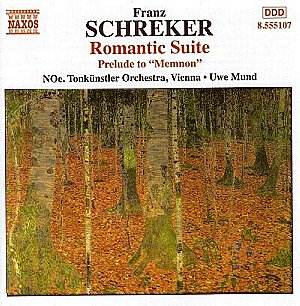
Franz SCHREKER (1878-1934)
Prelude to ‘Memnon’ (1933) [22.17]
Romantic Suite (1902) [27.13]
 NOe. Tonkünstler Orchestra, Vienna/Uwe Mund
Recorded in the ORF-Studio, Vienna, March 1988 DDD
NAXOS 8.555107 [49.30]
Franz Schreker occupies an odd position in our collective musical memory—not quite forgotten, but hardly central. This reissue from Naxos, originally released on Marco Polo in 1988, arrives at a moment when the Viennese composer’s reputation has been undergoing one of those periodic reassessments that the release industry both reflects and accelerates. We’re learning, slowly, that the early twentieth century produced more than Strauss, Schoenberg, and their immediate circles.
The Prelude to Memnon (1933) represents Schreker at the end—one of his final works, conceived as the opening to an opera he never completed. Perhaps couldn’t complete. By 1933 the climate had turned poisonous, and Schreker, already dismissed from his Berlin post, had less than a year to live. Yet the music itself shows no diminishment of craft. That opening horn call—noble, slightly exotic—establishes an Egyptian fantasia that unfolds with considerable sensuous appeal. The orchestration throughout displays that peculiar Schreker quality: a kind of hothouse luxuriance that suggests Strauss filtered through Debussy, with Mahler’s long-breathed melodies hovering in the background. When the clarinet enters with its sinuous line, one thinks inevitably of Salome, but Schreker’s harmonic language moves in its own orbit, more perfumed, perhaps more decadent.
The Romantic Suite comes from three decades earlier—1902, when Schreker was still in his twenties and the century itself seemed full of promise. It’s an astonishingly assured work for a young composer, recalling the precocious mastery of Korngold’s Sinfonietta in its confident handling of orchestral forces. The opening “Idylle” has genuine breadth; this isn’t miniature painting but something more ambitious. The scherzo that follows moves with quicksilver grace, and the string Intermezzo (originally a separate piece that won its composer a prize) proves real melodic invention. The finale, marked “Tanz,” functions as a proper symphonic conclusion—not merely decorative but structurally necessary.
Uwe Mund and the Tonkünstler Orchestra offer performances that are… serviceable. That’s perhaps too harsh. They’re competent, committed even, but this music requires more than competence. It needs the kind of sumptuous string tone and virtuosic wind playing that the BBC Philharmonic brings to their Chandos recordings under Sinaisky—which are, to be frank, superior in every respect save price. The ORF Studio recording from 1988 sounds decent enough, though the strings lack bloom and the brass occasionally turn strident in climaxes. One misses the demonstration-quality sound that Chandos provides.
At forty-nine minutes, the disc feels undernourished by contemporary standards. Surely something else could have been included—one of the orchestral interludes from the operas, perhaps, or the Kammersymphonie. Naxos has been generous elsewhere; here they seem oddly parsimonious.
Still, for those curious about Schreker—and you should be curious—this represents an affordable entry point. The Prelude to Memnon in particular deserves wider hearing, a late flower from a composer who watched his world collapse around him. The music itself remains seductive, troubling, never quite respectable. Rather like its creator.
Worth the modest investment, then, though those who find themselves drawn in should seek out the Sinaisky recordings. They reveal what this music can truly sound like when given performances to match its ambitions.