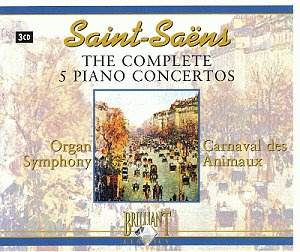
SAINT-SAENS The Complete 5 Piano Concertos
Camille Saint-Saëns (1835-1921)
Gabriel Tacchino (piano), Orchestra of Radio Luxembourg, Louis de Froment (conductor)
BRILLIANT CLASSICS 99524 (77:00 ; 67:53 ; 64:21)
Saint-Saëns: The Complete Piano Concertos; Symphony No. 3 “Organ”; Carnival of the Animals
There’s something almost poignant about hearing Gabriel Tacchino—Poulenc’s friend and a pianist of genuine distinction—trapped in these threadbare recordings. The man can play. Lord knows he can play. Those cascading runs in the Piano Concerto No. 2, the treacherous octave work that Saint-Saëns scattered through these pieces like land mines—Tacchino dispatches them with the kind of glittering ease that speaks to decades at the keyboard. But what surrounds him? That’s where this set collapses.
The Orchestra of Radio Luxembourg under Louis de Froment sounds under-rehearsed, perhaps under-interested. Listen to the opening of the First Concerto’s slow movement, where the lower strings should establish that dusky, evocative atmosphere. The intonation wavers. The pizzicatos later in the same movement—they’re not quite together, like musicians reading through the parts for the second time, not the twentieth. And the recording itself, licensed from Vox (though Brilliant Classics coyly buries this information), possesses that peculiarly harsh, empty quality one associates with budget productions from the 1960s. The piano’s upper register sounds brittle, almost tinny. The orchestral tutti lack body, weight, presence.
It’s maddening because occasionally—just occasionally—the music breaks through. Saint-Saëns has been called the French Mendelssohn, and there’s truth in that: both were prodigies, both wrote with infectious tunefulness, both have been dismissed as lightweight. His own remark about composing as naturally as an apple tree produces apples was meant as self-deprecation but became ammunition for critics who confused facility with superficiality. These concertos, though, reward serious attention. The Second, with its bizarre Bach-pastiche opening before the piano enters with those thundering chords. The Fourth, with its structural experiments. The Fifth, with its Egyptian exoticism that somehow never tips into kitsch.
But you need the right circumstances to hear them properly.
Stephen Hough’s Hyperion set—now that’s the standard. Breathtaking in the Second Concerto’s opening, where Hough finds poetry in those massive chordal statements. Angela Brownridge on ASV offers budget competition with better sound. The older cycles from Pascal Rogé with Dutoit (Decca), Jean-Philippe Collard with Previn (EMI), Aldo Ciccolini with Serge Baudo (also EMI)—all of these give you better orchestral playing, more refined recording, fuller sonic pictures. Even the historical set from Jeanne-Marie Darré, important for its period authenticity, has more character than this.
And then Brilliant Classics compounds the problem by padding this into a three-disc set. Most collectors want the concertos. Period. The Symphony No. 3 “Organ” here, with the Baltimore Symphony under Sergiu Comissiona, is pedestrian—no match for Dutoit’s blazing account, or Yan Pascal Tortelier’s, or Charles Munch’s legendary Boston recording. The release quality improves marginally, but only marginally.
As for the Carnival of the Animals on disc three… the two pianists (uncredited, naturally) seem to be performing in different postal codes. One sounds in-your-face, the other three rooms away. It’s almost comic, except you’ve paid for it.
Here’s what really troubles me: there’s no documentation. No recording dates, no venues, no liner notes worth mentioning. Just product, dumped onto the market to catch the rising tide of Saint-Saëns interest. It smacks of opportunism rather than advocacy.
Tacchino deserved better than this—his artistry, his understanding of the poetry in these scores, his sheer technical command all warrant proper sonic framing. That we can still hear his quality through these constricted, harsh recordings speaks to his gifts. But why settle for glimpses of excellence when you can have the full picture elsewhere? Even the most cash-strapped collector can find better options. The Rogé/Dutoit set often appears as a two-fer. Hough costs more but delivers transcendence.
This release feels like a missed opportunity, or worse, a cynical one. Saint-Saëns—that most elegant, most unjustly neglected of French masters—deserves champions, not this half-hearted repackaging of ancient tapes. Pass.