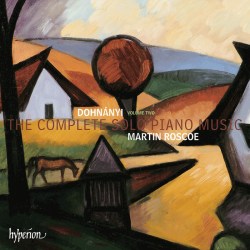
Dohnányi The Complete Solo Piano Music: Volume Two
Ernő Dohnányi (1877-1960)
Martin Roscoe (piano)
HYPERION CDA67932 (79:55)
There is a particular cruelty in how the repertoire treats certain composers — not by ignoring them outright, but by reducing a substantial legacy to a single calling card. Ernő Dohnányi has been sentenced to perpetual association with his Variations on a Nursery Song, that witty, irresistible orchestral romp from 1914 that concert programmers reach for whenever they want something crowd-pleasing but not embarrassingly so. The piece is genuinely delightful. It has also functioned, for decades, as a wall.
What lies behind that wall is considerable.
Dohnányi was born in Pozsony — Bratislava now — in 1877, and by the time he was twenty he had already absorbed Brahms with the thoroughness of a man who had studied at the master’s knee, which is very nearly what happened. The elder composer reportedly heard the young Dohnányi’s Piano Quintet in C minor and was moved enough to recommend its reading. That’s not nothing. That’s Brahms, who was not easily impressed.
This second volume of solo piano music concentrates on the years 1897 to 1907 — the period when Dohnányi was still a student at the Budapest Academy and then newly freed from it. The Four Piano Pieces Op. 2 open the program, and the first of them, a scherzo, announces itself with the kind of melodic confidence that composers usually take years to develop. The tune sticks. It will still be playing in your head while you’re making coffee the next morning — not because it’s cheap, but because it’s genuinely shaped, with a profile that Brahms might have admired and Schumann would have recognized as kin.
The two intermezzi that follow inhabit different emotional territories. The first moves with a certain harmonic restlessness — key relationships that shift just when you’ve settled into one — while the second slows everything down, drawing on Robert Reinick’s verses fashioned from the Book of Ruth. “Where you go I will go; where you lodge, I will lodge.” Dohnányi was thinking of Elsa Kunwald, his first wife — one of three, as it turned out, though presumably he wasn’t planning that far ahead. The music has the quality of a sincere vow, which makes it both touching and slightly bittersweet in retrospect.
The Capriccio that closes Op. 2 is the most technically demanding of the four pieces, the writing broadening outward structurally in ways that Brahms employed in his late intermezzi and capriccios — Op. 76, Op. 116 — though Dohnányi’s version has more swagger, less autumnal resignation. He was, after all, twenty years old.
Then there is the Variations and Fugue on a Theme of EG, Op. 4 — and here the source material runs out before it reaches its destination, which is frankly frustrating, because this work deserves more than a trailing sentence. Written just after Dohnányi left the Academy, it proves a formal mastery that most composers of his age couldn’t approximate. Variation form is a test. It demands that you honor a theme and escape it simultaneously, that each variation feel inevitable and surprising. The fugue that crowns the structure isn’t decorative; it’s structural, load-bearing, the capstone of a genuinely thought-out architectural plan.
The pianist here plays all of this with real care and evident affection for the repertoire — which matters, because this music requires advocacy, not just execution. There’s no Horowitz recording to compete with, no legendary Dohnányi self-disc from the 1930s hovering over the proceedings to make a younger pianist defensive. This is territory where the performer can plant a flag.
Whether the playing achieves the last degree of character — the scherzo’s grin, the intermezzo‘s ache, the fugue’s inexorability — is a question I’d want to sit with longer. But the case being made is real, and worth your time. Dohnányi wrote more than a party piece. This recording is evidence.