DELIUS Sea Drift; Appalachia; A Song Before Sunrise; La Calinda
Frederick Delius (1862-1934)
John Shirley-Quirk (bar), London Symphony Chorus, Royal Philharmonic Orchestra/Richard Hickox, Academy of St Martin in the Fields/Neville Marriner
ELOQUENCE DECCA 467 601-2 (76.30)
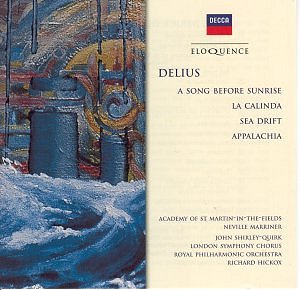
Delius: Sea Drift; Appalachia; “A Song Before Sunrise”; “La Calinda”
Delius remains one of those composers about whom strong opinions cluster like weather systems — passionate devotees on one side, the baffled or indifferent on the other. This Eloquence reissue won’t settle that argument. But it makes a persuasive case, on a budget, for two of his largest canvases alongside two miniatures that show what the man could do when he wasn’t trying quite so hard.
Marriner’s contributions here are the surprise. He was never a conductor you’d naturally associate with Delius — too brisk, too clear-headed, one might have assumed, for music that seems to ask for a certain willingness to dissolve. Not so. “A Song Before Sunrise” moves with real energy, almost impatient energy, the strings cutting cleanly through textures that some conductors allow to thicken into porridge. This is dawn as event, not mood. The cuckoo calls — those small, imperious woodwind interjections — land with something approaching wit. I hadn’t expected wit from Marriner in Delius. Pleasantly wrong.
“La Calinda,” that irresistible dance interpolated from Koanga, comes off lightly and with a kind of physical pleasure in the rhythm. The tambourine sits just far enough back in the mix to feel genuinely atmospheric rather than theatrical. There’s a slight crowding of tone when the climaxes pile up — inevitable, perhaps, with this acoustic — but the trumpet writing around the two-minute mark is dispatched with real panache. Clean attacks, warm tone, and a sense that the players knew exactly what they were doing.
Hickox is another matter, and a more complicated one. By 1977 he was past his earliest work — the Rubbra Masses for RCA feel like a different career — but he hadn’t yet settled into the Chandos years that would define him. Sea Drift is the more interesting of his two contributions here. The LSC produces a choral sound that one might charitably call atmospheric and less charitably call imprecise — the Whitman text disappears into a kind of tonal mist for long stretches. Yet this occasionally works in the music’s favor. When words do emerge with sudden clarity from that haze, the effect is genuinely striking, like a face appearing briefly in fog.
Shirley-Quirk, it must be said, takes time to warm up. The early pages feel slightly cautious, held back — whether from the singer’s own calculation or from uncertainty about ensemble I couldn’t say. But as Sea Drift builds toward its desolate conclusion, something opens up in the voice, and the final pages carry real emotional weight. He had a wonderful instrument, Shirley-Quirk. Even here, past what Barnett rightly calls the peak of his recording career, you hear the quality.
Appalachia is where Hickox’s limitations become more apparent. The grandeur is there — he clearly hears the scale of the thing, the long arc of the variations, the cumulative weight of the choral entry. What he misses, or at least underplays, is the yielding quality underneath — that sense of music breathing, of phrases that want to linger just a beat longer than the director allows them to. Barbirolli understood this instinctively. Beecham, in his final CBS album, understood it even better. Hickox’s Appalachia is capable and often impressive. But impressive isn’t quite the same as inhabited.
The recorded sound rewards a decent playback system — the Hickox sessions in particular have real weight and presence in the lower strings and bass voices. Christopher Palmer’s notes, reprinted from the original LPs, remain among the best short essays on these works; it’s a pity nothing similar was provided for the Marriner items, and the absence of precise session dates and locations is genuinely irritating for anyone who cares about such things.
Still. For the price, and for the combination of repertoire — Sea Drift and Appalachia on one disc with two of the most appealing miniatures Delius ever wrote — this is well worth having. Marriner alone makes it worth investigating.