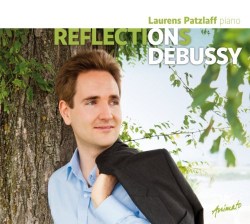
Reflections on Debussy
Claude Debussy (1862-1918)
Laurens Patzlaff, piano
ANIMATO ACD6134 (51:35)
There is something almost impertinent about placing your own improvisations alongside Debussy’s — not impertinent in a bad way, necessarily, but in the way a talented student might hang his sketches beside the master’s finished canvases. You notice the ambition. You also notice the distance.
Laurens Patzlaff has made exactly this gamble, interpolating his own keyboard improvisations between Debussy’s original pieces, each one growing from the work just heard and reaching toward the one about to come. The liner notes describe the exercise as a kind of bridging — thematic, atmospheric, connective tissue between inspirations. It’s a reasonable idea on paper.
But Debussy is brutal territory for a project like this.
Consider what we’re dealing with. This is a composer who spent years filing the rough edges off a single bar. The Préludes — to take the most obvious example — are not spontaneous-sounding so much as they are meticulously engineered to sound spontaneous, every blurred pedal marking and enharmonic sidestep calculated to feel inevitable. When Patzlaff improvises in the same sound world, reaching for those whole-tone shimmer effects, those suspended dominant ninths that never quite resolve, he catches something real. The atmosphere is genuinely Debussyan — the coloristic instinct is there, and on several occasions the harmonic imagination surprises you.
Still. The comparison is merciless, and Patzlaff seems to have invited it.
What this project most resembles, actually, is not Jacques Loussier’s jazz excursions through Bach — though that analogy isn’t entirely wrong — but rather the long tradition of composer-variations that runs from Brahms’s Variations on a Theme of Handel through Rachmaninoff’s Rhapsody on a Theme of Paganini and his Variations on a Theme of Corelli. In those works, a great composer absorbs someone else’s material and makes it entirely his own; you stop thinking about the original. Patzlaff’s improvisations, by design, never stop thinking about the original. They are constitutionally dependent on it.
That dependency is both their strength and their limitation.
When you hear one of Patzlaff’s transitions grow organically from, say, the falling minor thirds of “La cathédrale engloutie” and begin preparing you for what follows, there is a genuine musical intelligence at work — something a merely competent player couldn’t pull off. His touch is soft and searching, his pedaling idiomatic, his sense of pacing patient in a way that suits this repertoire. He doesn’t hurry. He understands that Debussy’s silences are structural, not decorative.
But then Debussy returns — the real thing — and the temperature in the room changes. Suddenly Patzlaff’s improvisation, which sounded quite lovely a moment ago, sounds like a draft. Not a bad draft. A draft.
I keep coming back to the question of format. If Patzlaff had recorded his improvisations alone, without the originals bracketing them, I suspect my response would be considerably warmer. Heard on their own terms, they reveal a sophisticated harmonic ear and a real feeling for modal ambiguity, for the kind of music that hovers in the air like smoke. The problem isn’t the improvisations. The problem is the juxtaposition — which the disc itself insists upon.
That’s ultimately the thing I can’t argue my way around. Debussy’s perfection isn’t the imperious, monumental kind — the way Beethoven can feel immovable. It’s something more intimate and more dangerous: a perfection that sounds fragile, almost accidental, as if the music might dissolve if you looked too hard at it. Patzlaff looks hard at it. He studies it closely. He responds to it with evident love.
But you can’t improvise your way into that kind of perfection. You can only stand near it and point.