BEETHOVEN Parthia Es-Dur Op. 103 / Rondo Es-Dur / Symphony No. 7 (Oslo Kammerakademi)
Ludwig van Beethoven (1770-1827)
Oslo Kammerakademi
LAWO CLASSICS LWC1036 (61:55)
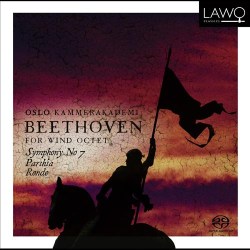
Wind music carries its own peculiar intimacy. The sounds are breath made audible — literal exhalation — and when eight players gathered in a Norwegian church manage to remind you of that fundamental fact, something genuinely rare is happening.
The Oslo Kammerakademi has made a disc that does exactly this, and it arrives at a moment when period-instrument wind playing has largely settled into comfortable habit. Too many ensembles in this repertoire split the difference between authentic practice and modern facility, ending up with neither the rawness of one nor the polish of the other. These Norwegians, playing in Bragernes Church with SACD engineering that captures the room’s natural resonance without bloat, have chosen a harder path — and it pays off with almost embarrassing generosity.
Start with the Beethoven Octet, Op. 103. The young composer — this is Beethoven still under thirty, still writing to please Viennese aristocrats who wanted their garden parties scored for eight players — packed the work with a kind of irrepressible animal energy that his later music would channel into more cosmic purposes. The opening Allegro bounces in with those cadential gestures that sound like someone who can’t quite suppress a grin. Oslo’s players understand this. The clarinets and bassoons carry a mellow, burnished warmth, while the natural horns — valveless, subject to the whole gorgeous gamble of hand-stopping — contribute a nasal, almost braying quality that no modern instrument can replicate. The contrast in color between these timbres is not incidental. It is the piece.
The Andante has something plaintive about it — the oboe in particular carries a slight catch in its tone, like a question not quite completed — and the ensemble’s intonation in the slow movement is, frankly, extraordinary. Tuning on natural horns is a negotiation, not a certainty, and hearing these players voice their harmonies with such precision while retaining the characteristic edge of period instruments is one of those experiences that reminds you why we bother with historical interpretation practice in the first place.
The Rondo Andante, sometimes treated as mere connective tissue, earns its place here. Beethoven originally attached it to the Octet before replacing it with the final Presto, and it functions on this release as a kind of breathing space — a divider between the Octet and the Symphony that follows. The horn duet at its center is something else entirely. There is something almost animal in how those notes get coaxed from the instruments, an elemental quality that no amount of refinement entirely domesticates. The players don’t try to smooth it away. Good.
Then — the Seventh Symphony. This requires some context. When the wind arrangement was published in 1816 (Beethoven’s own Seventh had premiered three years earlier, to somewhat delirious acclaim), the original edition was riddled with printing errors. Oslo has worked from the 2007 Bärenreiter Urtext and made their own corrections — a level of scholarly care that would be admirable even if the playing weren’t exceptional. But the playing is exceptional, and the decision to include timpani is the kind of thing that separates a thoughtful reconstruction from a mere curiosity. Hearing the Seventh‘s famous second-movement Allegretto — that inexorable, grief-soaked ostinato — rendered by winds with the low thud of timpani underneath gives the music a weight it might otherwise lose in translation. The Allegretto needs gravity. It gets it.
Comparisons? The old Netherlands Wind Ensemble recordings from the 1970s — Edo de Waart presiding over playing of exceptional clarity and corporate refinement — remain touchstones for this repertoire, and anyone who grew up with that sound will always hear it as a kind of baseline. But Oslo brings something those recordings didn’t always have: a quality of risk, of breath, of actual physical presence. The SACD surround mix contributes here, placing the listener inside the ensemble rather than in front of it.
This is a disc that makes you feel, physically, the pleasure of wind music — not as an interesting subset of the orchestral repertoire but as its own world, intimate and irreplaceable. Put it on when your spirits need lifting. They will be lifted.