String Quartet no.1 Alpine (1976) [13:23]
String Quartet no.2 Spring (1980) [12:59]
String Quartet no.3 Still Life with a Scream (1985-86) [21:06]
String Quartet no.4 Burning Time (1994) [13:58]
String Quartet no.5 Time that has Passed (2001) [30:02]
String Quartet no.6 Dramatic (2006) [13:41]
Noc Pozegnan (A Night of Farewells), for accordion and string quartet (1983/1995) [13:18]
Po Drugiej Stronie Lustra (Through the Looking Glass), for clarinet and string quartet (1988) [12:28]
Marek Andrysek (accordion)
Roman Widaszek (clarinet)
Silesian Quartet (Kwartet Slaski)
rec. Concert Hall, Karol Szymanowski Music Academy, Katowice, Poland, 7-28 April 2008. DDD
CD ACCORD ACD 173-2 [61:02 + 70:34]
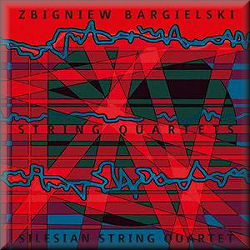 Polish music after 1945 is not a single story. It fractures almost immediately into competing impulses — the socialist-realist straitjacket, the sudden explosive liberation of the Warsaw Autumn festival from 1956 onward, the mystical retrenchment that overtook Górecki and Penderecki in middle age, the quieter radicalism of composers who never quite found their way onto the international circuit. Zbigniew Bargielski belongs to that last category, and the injustice of it becomes harder to ignore the longer you sit with these string quartets.
Born in the same decade as Górecki and Penderecki, he has watched both of them become, in their different ways, brands. Górecki’s Symphony No. 3 practically colonized the classical charts in the 1990s. Penderecki’s name is now shorthand for a certain kind of bristling, cluster-heavy modernism — though Penderecki himself spent decades trying to escape that reputation, with mixed results. Bargielski has had no such fame to flee and no such simplification to resist. He has simply composed.
What these quartets reveal is a musical intelligence that absorbed the Polish avant-garde fully enough to speak its language fluently, then developed its own grammar. The comparison that comes to mind — more apt, I think, than some of the booklet’s own suggestions — is Krzysztof Meyer, the Górecki student who has quietly accumulated one of the most substantial quartet cycles in contemporary Polish music. Like Meyer, Bargielski works in a modernist idiom that never mistakes difficulty for value. Dissonance earns its place here. So does silence.
The Fifth Quartet is the place to start. Not because it is the most dramatic — the Sixth, pointedly subtitled Dramatic, earns that designation — but because it offers the most welcoming entry into Bargielski’s thinking. The textures open gradually, the harmonic language reveals itself in layers rather than all at once, and the Silesian Quartet plays it with a kind of patient illumination, each phrase given space to register before the next arrives. You hear the rosin on the bow in the quieter passages, the slight catch before a high harmonic speaks. That specificity of sound matters enormously in this repertoire.
The Second and Third quartets are tougher propositions. Melodic contour is more elusive, rhythmic patterns more fractured, and a listener conditioned by the concert hall’s standard repertoire may feel, for a few minutes, as though the ground keeps shifting underfoot. It does. That is intentional. But Bargielski — and this distinguishes him from the more confrontational wing of the Polish avant-garde — never seems to want to punish the listener. The notes describe music that does not “violently and ostentatiously oppose tradition,” and the phrase rings true. Even in the most harmonically compressed moments of the Third, there is a kind of courtesy at work.
Each disc closes with a quintet. A Night of Farewells adds accordion — Marek Andrysek plays with a tone that is at once melancholy and slightly astringent, exactly right for Bargielski’s sound-world — and Through the Looking Glass brings in Roman Widaszek on clarinet, whose contribution is warmer, more lyrical, and opens up the texture in ways the pure string writing rarely does. Both pieces extend the quartet language rather than departing from it, and both soloists serve the music without calling undue attention to themselves. The real authority here, though, belongs to the Silesian Quartet. They have spent decades in precisely this territory, and it shows — not as routine but as genuine fluency, the kind that comes only from sustained commitment to a particular aesthetic world.
The recorded sound is superb, detailed without being clinical, captured in the quartet’s home environment with a naturalness that suits the music’s own refusal of ostentation. Andrzej Chlopecki’s booklet notes are exemplary — scholarly, specific, and written with real affection for the subject.
One caveat: the discs do not claim to represent Bargielski’s complete quartet output, and at least one additional work from 1991 appears in other sources. The picture here may be incomplete.
It doesn’t feel incomplete. It feels like a discovery — one of those recordings that makes you wonder, with some irritation, why it took this long.