DEBUSSY Pelleas et Melisande (Bernard Haitink)
Claude Debussy (1862-1918)
Anne Sofie von Otter (soprano), Wolfgang Holzmair (baritone), Laurent Naouri (baritone), Hanna Schaer (mezzo soprano), Alain Vernhes (bass), Florence Couderc (soprano), Jérôme Varnier (baritone), Chorus of Radio France, Orchestre Nationale de France, Bernard Haitink (conductor)
NAÏVE V 4923 (161:14)
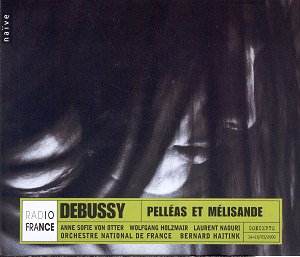
Debussy: Pelléas et Mélisande
There is no other opera quite like this one. None. Debussy spent the better part of a decade wrestling it into existence — from his first encounter with Maeterlinck’s play in 1893 to the premiere at the Opéra-Comique nine years later — and what emerged was something so singular, so resistant to category, that even now audiences sometimes sit in a kind of bewildered suspension, unsure whether they’ve been moved or merely hypnotized. Both, I think. Always both.
The story behind the collaboration is worth rehearsing briefly. Debussy had been searching, almost desperately, for a text that would leave room for music to inhabit — not illustrate, not decorate, but inhabit. He found it in Maeterlinck’s symbolist drama, a work already haunted by silences, by things unsaid and unsayable. Mélisande herself embodies this: she arrives from nowhere, explains nothing, loves fatally, and dies with the same elusive opacity with which she lived. Who is she? Where did she come from? The opera never tells us. Debussy understood that this was not a dramatic weakness but the whole point.
His solution — continuous, almost seamlessly flowing music that shadows the natural rhythms of French speech, avoiding the square-cut aria entirely — was radical in 1902 and remains startling today. The Wagnerian shadow falls across the score, certainly. The leitmotif is there, the post-Tristan harmonic world is there, the mythic atmosphere of Parsifal hangs in the air like incense. But Debussy dissolves all of it into something characteristically, unmistakably French: luminous, reticent, trembling at the edges.—Haitink gets this. Profoundly.
His tempos breathe. That is the first thing you notice — the music never feels pushed, never feels held back artificially, just breathes, the way the score demands. The Orchestre National de France plays with a tonal refinement that seems almost bred into them; the string sound in the opening forest scene has that particular quality of filtered light, neither warm nor cool exactly, and the woodwind soloists — the oboe especially, in those spare melodic fragments that float above the texture — play with the kind of self-effacing artistry that is actually quite hard to achieve.
The storm at the close of Act I is handled with exactly the right degree of restraint. Haitink doesn’t whip it up into Wagnerian fury; instead it gathers, darkens, subsides — a threat half-realized. And the fountain scene that opens Act II, with its shimmering, almost Impressionist watery textures, is simply luminous. You can hear the stillness of the water before the ring falls.—Anne Sofie von Otter’s Mélisande is — well, I’ve been sitting with this recording for some time now, and I keep returning to the same word: inevitable. Her voice has that quality of seeming to exist slightly outside ordinary human time. The tone is pure without being cold, the French is idiomatic and natural, and she brings to the role a quality of innocent danger that is very hard to define and absolutely essential. When she tells Golaud she is not happy — “Je ne suis pas heureuse ici” — the understatement lands like a blow. She doesn’t reach for it. It’s just there.
Wolfgang Holzmair’s Pelléas is a fine, intelligent reading — the voice is perhaps a shade light for the role’s climactic moments, and there are places in Act IV where you wish for more sheer weight. But his musical instincts are impeccable, and the erotic tension between his Pelléas and von Otter’s Mélisande in the tower scene — her hair cascading down, his voice rising with something between worship and desperation — is genuinely electric. The hair. Debussy makes so much of the hair. It’s almost comically overdetermined as a symbol, except that somehow it never is.—Laurent Naouri’s Golaud is the revelation of the set.
The voice is rich, dark, capable of sudden violence — and Naouri uses it with considerable dramatic intelligence. This is a man who destroys what he loves, and knows it, and cannot stop himself. The scene in which he forces the child Yniold to spy on the lovers is chilling, partly because Naouri never quite tips over into melodrama. Florence Couderc’s Yniold is touching and bright-toned; Alain Vernhes brings a grave, almost Wagnerian authority to Arkel, the blind old king whose wisdom never quite manages to prevent catastrophe.
Hanna Schaer’s Geneviève is solid if not especially memorable — though the role gives her little room to make a strong impression in any case.—The live provenance of this recording (the Théâtre des Champs-Élysées, March 2001) is occasionally audible — a cough here, a slight roughness in the hall acoustic there — but these are minor irritants. What the live context gives back is a sense of occasion, of music being made in real time by people responding to each other, and that matters enormously in this opera. Pelléas dies in the studio if it isn’t carefully handled. Here it lives.
There are distinguished competitors, of course — Karajan’s DG release with Ghiaurov and Freni, Abbado’s Deutsche Grammophon set, the old Ansermet on Decca that remains in many ways unsurpassed for sheer Gallic atmosphere. This Haitink doesn’t displace all of them. But it belongs in the conversation, and von Otter’s Mélisande alone is reason enough to own it.
Magical, yes. But more than that — true.