BEETHOVEN Complete String Quartets (Talich Quartet)
Ludwig Van Beethoven (1770-1827)
Talich Quartet (Petr Messiereur (violin I); Jan Kvapil (violin II); Jan Talich Sr. (viola); Evzen Rattay (cello))
LA DOLCE VOLTA LDV 121.7 (7 CDs: 72:49 + 72:38 + 73:17 + 71:56 + 72:58 + 71:12 + 67:12)
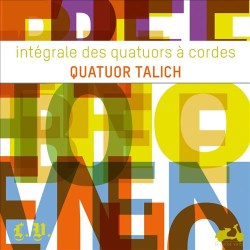
Something has always struck me as quietly radical about the Talich Quartet’s approach to Beethoven — not radical in the sense of overturning received wisdom, but radical in the older, more literal sense: going to the root of things.
These are Czech musicians. That matters. Jan Talich, who founded the quartet in 1964, carried the name and something of the spirit of his uncle Václav Talich, who shaped the Czech Philharmonic into one of the great orchestras of the mid-century and whose recordings of Dvořák and Smetana still sound as though the music grew out of the earth rather than off a printed page. There is a particular instrumental culture in Central Europe — not German exactitude, not Viennese sweetness exactly, but something earthier, more unsentimental, with an instinctive feel for the long melodic line and an equally instinctive suspicion of prettiness for its own sake. You hear it in this Beethoven.
The sixteen quartets span roughly a quarter century of Beethoven’s creative life, from the Op. 18 set — polished, sociable, already showing the occasional flash of something that would embarrass Haydn — through the middle-period masterworks and on to the late quartets, which remain among the most demanding, most private, most inexhaustible music ever written. A complete cycle is not merely a disc project. It is a statement of belief.
Modern ensembles tend to stake out territory. At one extreme you have the Quartetto Italiano — lean, transparent, almost crystalline in its refusal of weight, as though the players believed their job was to hold the music up to the light rather than live inside it. At the other, groups like the Emerson or the Takács go in close, emphasizing the physical friction of bow on string, the grain and grit of the instruments themselves — an approach partly indebted to the period-rendition movement’s insistence that Beethoven’s sound world was rawer, less padded, than the nineteenth century made it. Both strategies have produced great recordings. Both can also produce recordings that feel like arguments rather than music.
The Talichs refuse the argument. They play, it seems, from the inside out — not from a theoretical position but from long habituation to this music, a habituation that shows in the smallest details. The cello of Evžen Rattay has a particular quality: mellow and full without ever becoming lush, capable of anchoring the texture without smothering it. When Beethoven gives the cello one of those long, low-lying melodies — the slow movement of Op. 59, No. 1, say, which begins down in the instrument’s least glamorous register and stays there, refusing all consolation — Rattay plays it with an almost conversational directness, as though explaining something complicated to someone he trusts.
What you notice first, listening across the cycle, is the consistency. Not uniformity — these players have individual voices, and you can hear the slight difference in color between any two of them — but a consistency of approach, of mutual listening, that only comes from long years of playing together. Jan Talich junior joined in 1997, and by the time these recordings were made the ensemble had absorbed him so thoroughly that the ensemble voice is seamless.
The early quartets can be a trap. Play them too lightly and they seem trivial; play them with the full weight of what Beethoven would become and they seem falsified. The Talichs find a middle way — they bring the Op. 18 quartets something like their full expressive attention without anachronistically loading them with late-quartet gravitas. The finale of Op. 18, No. 4, in C minor has real urgency; the slow movement of Op. 18, No. 6 has genuine tenderness. But neither sounds like a preview of Op. 132.
The middle quartets — the three Razumovskys of Op. 59, the Harp, the Serioso — get playing of real stature. Op. 59, No. 3 is one of Beethoven’s most outwardly brilliant quartets, all hard surfaces and driving energy, and it can sound merely efficient in the wrong hands. Here it sounds inevitable. The fugue in the finale crackles without becoming mechanical. The slow introduction — that long, hovering uncertainty before the C major theme arrives — is held with extraordinary patience.
Then the late quartets. Op. 131, Op. 132, Op. 130 with the Grosse Fuge — these are works that have defeated more than a few distinguished ensembles, not because the notes are unplayable but because the music demands a quality of sustained inwardness that is genuinely rare. The Talichs don’t pretend to mysticism. What they offer is something perhaps more valuable: clarity. The seven-movement arch of Op. 131, played without a break, unfolds here with the logic of a long argument heard whole rather than in pieces. The Cavatina of Op. 130 — that achingly slow middle section marked beklemmt, oppressed, constricted — is played without exaggeration, which paradoxically makes it more affecting.
La Dolce Volta has served these recordings well. The sound is natural and present without being artificially close — you hear the instruments as instruments, but also as voices in conversation.
Where does this cycle rank? The Végh Quartet’s set — recorded in the early 1970s and now maddeningly difficult to find — remains for me the standard against which all others are measured, partly because of its unique combination of wisdom and wildness. The Quartetto Italiano is the choice for those who want purity. The Takács brings a visceral excitement that is genuinely its own. The Talichs are perhaps closest in spirit to the Budapest Quartet recordings of the 1950s — not in sound, but in their fundamental seriousness, their refusal of display, their conviction that the music is enough. That is not a small thing to say.