Wilhelm Friedemann BACH (1710-1784) Keyboard Works – Vol. 3
Wilhelm Friedemann Bach (1710-1784)
Julia Brown, harpsichord
NAXOS 8.572814 (75:37)
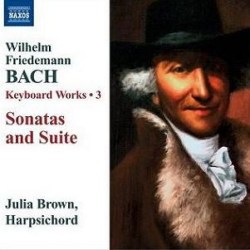
Wilhelm Friedemann Bach has been ill-served by history in almost every conceivable way. The rumors — dissolute habits, wasted genius, Oedipal resentment toward the great father — have proven stickier than the music itself, which is a genuine shame, because the music is extraordinary. Carl Bitter’s 1868 biography and Brachvogel’s lurid bio-fantasy did their damage early, and the internet has only compounded the mischief. You can find the old slanders confidently repeated on otherwise respectable websites, sometimes lifted wholesale from Wikipedia entries that have long since been corrected. The actual scholarship — and there has been good scholarship, particularly around the tricentenary of Friedemann’s birth in 2010 — barely registers by comparison.
Julia Brown is having none of that. Her second volume of Friedemann’s keyboard music for Naxos concerns itself strictly with what matters: the notes on the page and what a skilled, thoughtful player can make of them.
What she makes of them is considerable.
Friedemann occupied a peculiar position in the Bach family constellation — eldest son of Johann Sebastian, trained with ferocious rigor at the keyboard, and possessed of a harmonic imagination that sometimes leaves his father’s orbit entirely and points toward a strangeness all his own. Where C.P.E. mapped the emotional turbulence of Empfindsamkeit with something approaching systematic intent, Friedemann’s oddities feel less programmatic, more constitutional. His chromaticism doesn’t announce itself; it simply arrives, as if that were the only logical next step.
Brown plays harpsichord here, a sensible choice given that Friedemann — like his father — rarely specified an instrument. The decision shapes everything. On a modern concert grand these fantasias can sound almost Schumannesque in their waywardness; on the harpsichord they retain a certain angular clarity, the registral contrasts doing work that pedaling and tonal gradation would otherwise handle. Brown understands this. She doesn’t try to make the harpsichord into something it isn’t.
Her ornamentation is precise without being fussy. The fantasias in particular — formally the freest things Friedemann wrote, and among the freest keyboard pieces of the entire eighteenth century — demand a player who can sustain rhetorical tension across passages that seem to be improvising their own structure as they go. Brown does this. The fugues, kept separate from the fantasias on the disc in a way that mirrors Friedemann’s own practice, are clean and purposeful without sacrificing character.
Robert Hill’s first Naxos volume, which appeared in 2007, remains a touchstone — his accounts of the Polonaises and the Sonata in D on period fortepiano have a mercurial authority that’s hard to match. Brown is a different kind of player, cooler in temperament, perhaps more architecturally minded. Neither approach is wrong. They illuminate different facets of a composer who resists being pinned down.
One small complaint: Naxos has again used the same portrait of Friedemann on the cover — the one traceable to Martin Falck, the early cataloguer responsible for the “F” numbering system still in use. The portrait is not unattractive, but it has a slightly dissolute, louche quality that rather reinforces the myth this music should be dismantling. Three volumes, same image. Someone at the label should reconsider.
But the booklet notes are good — Brown writes about the music, not the legend — and the recorded sound is honest and well-balanced.
Friedemann deserves an audience. This disc, like its predecessors in the series, goes a real distance toward earning him one.