Piano Sonata No.30 in E major Op.109
Piano Sonata No.31 in A flat major Op.110
Piano Sonata No.32 in C minor Op.111
Piano Sonata No.4 in E flat major Op.7
Piano Sonata No.17 in D minor Op.31 No. 2 Tempest
Piano Sonata No.18 in E flat major Op.31 No. 3
Piano Sonata No.3 in C major Op.2 No.3
Piano Sonata No.28 in A major Op.101
Piano Concerto No.3 in C minor Op.37
Sviatoslav Richter (piano)
Moscow Youth Symphony Orchestra/Kurt Sanderling (Concerto)
rec. live 22 March 1952 (Op. 37); 10 January 1965 (Op. 31 Nos. 2, 3; Op.90); 10 October 1965 (Opp.101, 110); 22 January 1972 (Op.109); 12 January 1975 (Op.2 No.3; Opp.7, 111) ADD
BRILLIANT CLASSICS 94399 [3 CDs: 74:19 + 73:32 + 79:57]
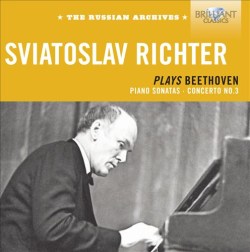 Sviatoslav Richter never made a studio recording of the Beethoven piano sonatas. Not one. That fact alone should give pause — this was a pianist who commanded the repertoire with an authority that made other interpretations seem tentative by comparison, and yet he apparently found the studio’s artificial stillness inhospitable to what he needed to do with this music. So we are left, as we so often are with Richter, to piece together the picture from live recordings of wildly varying provenance, many of them sounding as though they were captured on a wire recorder smuggled past Soviet border guards in someone’s coat lining.
Which makes this Brilliant Classics release genuinely useful, whatever its commercial complications.
The three late sonatas — Opp. 101, 109, and 110 — come from 1965 and 1975, with the 1975 sessions producing sound that is, by Soviet live-recording standards, almost luxurious: full, present, only occasionally boxy. The 1965 recording of Op. 101 is another matter. There is distortion in the second movement’s hammered opening chords that cannot be wished away, and in the Andante of Op. 109, pitch fluctuations flutter through the original tape like something heard through a half-open window in a neighboring room. You notice it, wince, and move on — because the alternative is not listening to Richter play Op. 109, which is no alternative at all.
What strikes you immediately about Op. 101 is how un-monumental it sounds. Where Glenn Gould made the late Beethoven into a kind of private philosophical argument conducted at the keyboard, and Wilhelm Kempff turned it into something autumnal and ruminative, Richter finds in Op. 101 an almost improvisatory freedom — Romantic in the deepest sense, as though the architecture were being invented on the spot rather than realized from a blueprint. The opening movement floats. The march that follows it does not merely march; it insists, with a rhythmic exactitude that makes the distorted chords feel almost violent by contrast.
Op. 110 has coughing. Quite a lot of it, concentrated in the most exposed passages, which is the kind of thing that makes you want to say something uncharitable about concert audiences — but Richter’s playing in the Arioso dolente is so inwardly concentrated that the coughing somehow registers as an intrusion from another world, which in a sense it is.
And then there is Op. 111, recorded in 1975, and here the sound opens up into something genuinely fine. The Allegro con brio ed appassionato — that movement “Beethoven ”apparently told Schindler required no second sonata to follow it because it said everything that needed saying — arrives at a tempo that most pianists wouldn’t attempt and that Richter makes sound inevitable. Fierce is the right word for it. The intensity is physical, almost tactile; you can hear the mechanism of the Hammerklavier responding to an extraordinary demand. And then the Arietta: unhurried, vast, the variations accumulating like weather moving across a plain. This is Richter at the height of his powers, and no amount of background noise changes that.
The concerto is a different proposition altogether — mono, recorded in 1952 with a conservatory student orchestra conducted by Kurt Sanderling, who was then making his difficult life in the Soviet Union after fleeing Germany. Sanderling was a real performer, formed in the Klemperer tradition, and he handles the orchestral tuttis with more authority than the forces under him might have suggested possible. But this is essentially a historical document, interesting in the way that Richter’s early recordings are always interesting — you can hear the pianist he was becoming — rather than a reading that competes on equal terms with, say, his 1958 disc with Mravinsky, which remains one of the great accounts of the Third Concerto on record.
Brilliant’s repackaging habits are notoriously casual about context and annotation. This release strips the Beethoven from a five-disc set that also contained the Liszt B minor sonata and four Schubert sonatas — so buyers who already own those performances elsewhere get exactly what they want, and Richter completists who want everything in one place get less than they bargained for. Worth knowing before you order.
None of it matters very much in the end. Richter’s Beethoven discography is labyrinthine, his recorded legacy a thicket of competing editions and label claims, and any reasonably clean version of these performances is worth having. The 1975 recordings especially — Op. 109 despite its tape problems, Op. 110 despite its coughers, Op. 111 in its blazing entirety — represent a musical intelligence working at the outermost edge of what the instrument can express. You don’t pass that up because the packaging is confusing.