Concerto in E flat major (reconstruction based on BWV 169, 49, 1053) [16:18]
Concerto in D minor (reconstruction based on BWV 1059) [12:02]
Concert in C minor (reconstruction based on BWV 1060) [14:05]
Georg Philip TELEMANN (1681-1767)
Concerto in G major [13:20]
Concerto in G major [6:44]
Lars Anders Tomter (viola)
Martin Kuuskmann (bassoon)
1B1 – Jan Bjøranger (leader)
rec. 18-22 January 2012, Tanager Church, Sola, Norway
SIMAX CLASSICS PSC1326 [65:08]
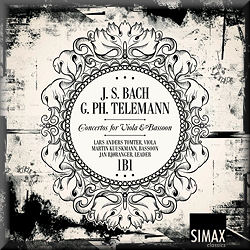 Pleasure, not provocation, is the governing principle here — and that’s not necessarily a complaint. Lars Anders Tomter and Martin Kuuskmann have reconstructed these Bach concertos for viola and bassoon respectively, and the results are, on their own terms, consistently persuasive. Whether they’re essential is another matter.
Start with what works. Tomter’s arrangement of the Concerto BWV 1053 — originally written, most scholars believe, for harpsichord — trades that instrument’s bright, percussive attack for the viola’s deeper, more reticent voice. Something is lost, inevitably. The sheen, the sparkle. But the slow movement gains a quality of inwardness that the harpsichord, for all its charm, can’t quite reach — Tomter phrases with the patience of someone who knows exactly where the line is going before it arrives.
Kuuskmann’s bassoon is if anything better suited to these transpositions. The Concerto BWV 1059, fragmentary in its original form and here given a plausible completeness, shows off a player who understands that virtuosity in this repertoire means restraint as much as display. His tone in the lower register has a wonderful dark bloom to it. The double concerto BWV 1060 brings the two soloists together, and the pairing is shrewder than it might look on paper — the bassoon’s natural buoyancy against the viola’s gravity creates a genuine dialogue, particularly in the central Adagio, where the two instruments seem to be finishing each other’s thoughts.
The 1B1 ensemble accompanies with just the right weight — light enough to let the soloists breathe, present enough to remind you that these are concertos, not sonatas with optional background. The harpsichord continuo sits low in the texture but generates a satisfying rhythmic thrumming when the music needs it, and the recorded acoustic, intimate without being claustrophobic, serves the whole enterprise well.
Then there’s Telemann. The Viola Concerto in G major and the double concerto — adapted from an original for two violas — are, to be honest, a relief after the weight of Bach’s demands. Telemann was an entertainer of genius, and he knew exactly how to deploy the style galant’s directness without sacrificing craft. These are not lesser pieces. But hearing them alongside Bach is a reminder that genius and talent, however closely they may travel, are not the same destination.
The reservation I keep returning to is this: novelty of instrumentation aside, there’s little here to disturb your settled assumptions about any of this music. The performances are accomplished, sometimes genuinely lovely, always tasteful. Tasteful. That word, which ought to be a compliment, has a way of becoming a gentle accusation. Nothing here reaches for anything that feels genuinely dangerous or surprising — no phrase shaped against expectation, no tempo that makes you sit forward. Tomter himself argues, in his booklet notes, that Bach’s music is open to many interpretations. True enough. But openness to interpretation implies actually choosing one.
Still. The booklet is informative, the recorded sound is clean and well-proportioned, and anyone with affection for this repertoire will find much to enjoy. Warmly recommended, then — with the understanding that warm recommendation and unqualified enthusiasm are not always the same thing.