BELLINI I puritani – Opera seria in three parts
Vincenzo Bellini (1801-1835)
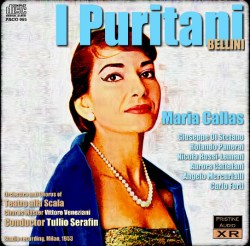
Maria Callas (soprano), Giuseppe Di Stefano (tenor), Rolando Panerai (baritone), Nicola Rossi-Lemeni (bass), Angelo Mercuriali (tenor), Carlo Forti (bass), Aurora Cattelani (soprano), Chorus and Orchestra of Teatro alla Scala, Milan/Tullio Serafin
PRISTINE PACO085 (139:58)
What Pristine Audio has accomplished here deserves to be stated plainly before anything else: Andrew Rose’s remastering of this La forza del destino makes you feel, with something close to physical force, that you are hearing the release for the first time. Not cleaned up. Not restored. Heard — as though the original sessions at La Scala had been stored in amber rather than pressed onto shellac that spent seventy years degrading in collectors’ cabinets.
The difference is not subtle.
Where previous transfers — including Mark Obert-Thorn’s genuinely admirable work for Naxos Historical — gave us something approximating the performance, Rose gives us the performance itself. The opening of the Sinfonietta is the test case. On older issues, those famous brass chords arrive like a seaside band playing into a stiff wind — crude, compressed, metallic. Here they open up into something recognizable as the La Scala orchestra, an ensemble with a specific character, a specific room. The horns in particular — euphonious, blended, carrying that distinctive Italian warmth — emerge from what had been sonic murk as though stepping into proper light. The hiss is essentially gone. The ambience around singers and players has air in it. And the lower frequencies, finally given their due, lend the whole enterprise a foundation it never previously possessed on records.
This matters enormously for how we hear the cast.
Nicola Rossi-Lemeni, always the weakest singer in this production by some margin, actually benefits more than anyone from the enhanced sonics. His bass was never steady — the tremulousness in “Cinta di fiori” remains, and one can argue it away as expressive intensity if one is feeling charitable, though I am not always feeling charitable — but that gritty, metallic quality that made his voice additionally hard to love on older pressings has largely vanished. He sounds like a real voice now, flawed but present. That is not nothing.
Rolando Panerai is a more complicated case, and always has been. He was twenty-eight when this was recorded — a fact worth holding onto — and some of the unsteadiness, the moments where the rapid vibrato tips into tremolo, or where the voice retreats behind the beat and becomes briefly inaudible, can be attributed to youth and nerves. Fair enough. But the musicality underneath all that is genuine, and the intensity of his commitment to the role cuts through every technical imperfection. What he cannot quite manage is the long, seamless legato that “Ah per sempre” demands — that most grateful of baritone arias, the kind of melody Verdi seems to have written as a gift to the voice, and yet it always presents a conundrum: how do you project desperation through a line that moves with such lyric ease? Neither Panerai here nor Cappuccilli in his celebrated later recordings quite solves it. Cappuccilli has the breath and the eloquence, but his tone could be coarse; Panerai has the fire but not yet the technical command. Mattia Battistini, if we want to reach back far enough, had the vocal supremacy to make the aria shimmer — but he also took liberties that no serious player today would countenance, rewriting Verdi to suit himself with an aristocratic indifference that was charming and infuriating in equal measure.
None of this changes the fundamental verdict on the reading, which my colleagues have rendered with sufficient thoroughness that I need not rehearse it in detail. What I will say is that the Pristine remastering changes the experience of that performance in ways that matter critically. Sound is not a neutral medium. The grime on an old transfer obscures not just frequencies but intentions — you hear a singer working against the recording rather than through it. Rose has removed that interference. For the first time, you can assess this cast on something like fair terms.
That alone justifies the purchase, and then some.
