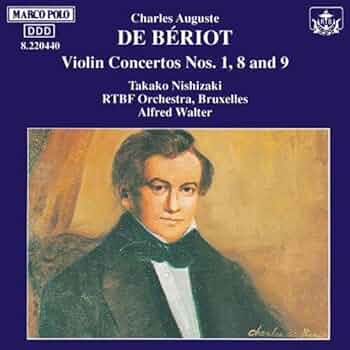
Charles-Auguste de Bériot: Violin Concertos nos. 1, 8, and 9
Takako Nishizaki, violin. RTBF Orchestra; Alfred Walter, conductor.
Marco Polo 8.220440. Recorded 1986, Brussels. Compact disc, 50:05.
The Belgian violin school—what a curious footnote it has become in our musical consciousness. We remember Vieuxtemps, perhaps Ysaÿe if we’re feeling complete, but Charles-Auguste de Bériot? The name hovers somewhere in the pedagogical ether, attached to études that torture intermediate students. This Marco Polo disc, recorded in Brussels in 1986, makes a modest case for reconsidering that dismissal.
Not, mind you, that these three concertos will dislodge Mendelssohn or Brahms from anyone’s affections. The Concerto no. 1 in D Major, composed in 1829 and premiered by Bériot himself on Christmas Day of that year, runs barely thirteen minutes—a party piece, really, though one requiring considerable left-hand pizzicato and the kind of operatic cantilena that contemporary critics compared to Bellini. The comparison isn’t entirely fanciful. Listen to how the melodic line unfurls in the central section, all languid arabesques and calculated sighs. This is music designed to seduce rather than challenge, to display rather than probe.
The debt to Paganini hangs heavy over this score. But where Paganini’s virtuosity often served diabolical invention, Bériot’s feels more genteel. Domesticated, perhaps. The technical demands are real enough—that left-hand pizzicato isn’t mere decoration—but everything remains within the bounds of good taste. Nothing disturbs the salon.
By the time we reach the Concerto no. 8 in D Major from 1855, Bériot had absorbed a quarter century of Romantic development. The work sprawls across three movements (though played without pause), and the melodic invention shows greater confidence. The slow movement particularly catches the ear—there’s a vulnerability in those decorated phrases that transcends mere display. Then the "finale" arrives with its spirited energy, and we’re back in the world of calculated brilliance. One understands why these works vanished from concert programs. They’re too substantial to serve as encores, too slight to anchor a program. An economic problem as much as an artistic one.
The Concerto no. 9 in A Minor continues in similar vein. Three movements, played continuously, dedicated to Princess Tatiana Yusupov (the eighth went to her husband, Prince Nikolai—one imagines interesting drawing-room dynamics). Bériot’s fluency never falters, but neither does it surprise. The "Allegro" maestoso opening promises more than it delivers; the "Adagio" offers genuine feeling without memorable thematic material; the "Rondo": Allegretto moderato concludes with professional competence.
Which brings us to Takako Nishizaki, who navigates these scores with bright tone and unfailing energy. Her technical command never wavers—those left-hand pizzicatos snap cleanly, the double stops ring true, the runs emerge with crystalline clarity. What’s missing, perhaps, is a sense of personal investment. She plays at this music rather than through it, delivering the notes with admirable accuracy but limited interpretive insight. The tone itself remains somewhat one-dimensional; Bériot’s melodies cry out for timbral variety, for those subtle gradations of color that transform display into expression.
Alfred Walter and the RTBF Orchestra provide solid support, nothing more. The orchestral writing makes few demands—Bériot understood his role in the soloist-orchestra relationship—and Walter doesn’t search for profundities that aren’t there. The disc places Nishizaki well forward, which serves the music’s intentions if not always the listener’s comfort. That Brussels acoustic offers warmth without much detail.
The liner notes, credited to Raymond J. Walker, provide adequate biographical context but frustratingly little analytical insight. We learn about Bériot’s marriage to Maria Malibran, his teaching position at the Brussels Conservatoire, his eventual blindness and paralysis. What we don’t learn is why these particular concertos matter, what distinguishes them from their siblings, why we should care about this music beyond historical curiosity.
And that remains the central question. These are well-crafted works that served their purpose—vehicles for a virtuoso who helped establish the Franco-Belgian school at its zenith. They contain passages of genuine charm, moments where melody and mastery align in satisfying ways. But they don’t transcend their origins. They remain period pieces, interesting primarily for what they reveal about mid-nineteenth-century taste and violin pedagogy.
The disc offers fifty minutes of pleasant music, competently performed and adequately recorded. For scholars of violin history or completists exploring the Romantic concerto repertoire, it holds genuine interest. For general collectors, it’s harder to justify. That economic problem Bériot faced—how to program these thirteen-minute works—persists in the home listening environment. They’re too slight to demand full attention, too substantial to serve as background.
A respectable effort, then, but not an essential one. The Belgian violin school produced greater works than these, and even within Bériot’s output, one suspects there might be stronger choices. This disc documents without quite advocating, preserves without fully persuading. Sometimes that’s enough. Sometimes it isn’t.