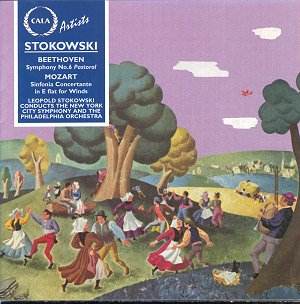
Mozart: Sinfonia Concertante, K. 297b. Beethoven: Symphony no. 6 in F Major, op. 68, “Pastoral”
Marcel Tabuteau, oboe; Bernard Portnoy, clarinet; Sol Schoenbach, bassoon; Mason Jones, horn. Philadelphia Orchestra (Mozart, 1940); New York City Symphony (Beethoven, 1945); Leopold Stokowski, conductor.
Cala Records CACD 0523. Compact disc, 76:22.
Stokowski’s Case for the Defense
There’s always been this tiresome notion—perpetuated by people who should know better—that Stokowski couldn’t be trusted with the Viennese classics. Too much Hollywood, too much shimmer and hocus-pocus. Well, here’s your answer, preserved in transfers that let you hear exactly what he was up to in 1940 and 1945.
The Mozart Sinfonia Concertante, K. 297b, comes from Philadelphia, naturally, when Stokowski still had at his disposal what may have been the finest woodwind section ever assembled in an American orchestra. Marcel Tabuteau—oboist, pedagogue, legend—had been there a quarter century by then. His sound, that particular burnished gleam, remains instantly recognizable. But listen to Bernard Portnoy’s clarinet work here: the phrasing breathes with an almost vocal plasticity, the articulation so clean you can hear the pad work, yet never fussy or self-regarding. Sol Schoenbach and Mason Jones complete what amounts to a dream team.
And Stokowski? He doesn’t get in their way, which is itself a kind of wisdom. The orchestral textures—those inner string parts that can so easily turn muddy—remain transparent without being etiolated. Tempos flex but never collapse into mannerism. There’s genuine Affekt in the slow movement, not the treacly sentiment some might expect. This is Mozart playing that belongs in any serious discussion of the work’s recorded history, full stop.
The Beethoven Sixth presents a different proposition entirely. Recorded at Carnegie Hall with the short-lived New York City Symphony—an orchestra Stokowski briefly led after his Philadelphia departure—this 1945 Pastoral predates his later NBC version by a decade. The documentation here gets murky: apparently RCA tried to disguise the orchestra’s identity on some LP releases, calling it the “Sutton Symphony Orchestra,” which tells you something about corporate shenanigans in the LP era.
What strikes you immediately is the first movement’s forward propulsion—this isn’t the leisurely country stroll you might anticipate. Stokowski drives it with real purpose, though never at the expense of Beethoven’s carefully calibrated dynamics. But then comes “Scene by the Brook,” and yes, it’s sixteen minutes long, which will send some listeners screaming for the exits. Is it indulgent? Perhaps. Is it also deeply considered, with extraordinary attention to the interplay between those woodwind birdcalls and the underlying string murmur? Absolutely.
The storm has the visceral impact you’d expect—Stokowski knew how to build a climax—but what impresses more is the transition into the "finale", where he finds genuine spiritual release rather than mere relief. The orchestral playing isn’t quite at Philadelphia’s level; there are moments where ensemble precision falters slightly. But the interpretation holds together through sheer conviction.
Cala’s transfers deserve praise. They’ve managed to preserve the warmth of the original sound without excessive filtering or digital gloss. You hear the hall acoustic in the Beethoven, that particular Carnegie dryness that later recordings would try to ameliorate. The Mozart captures Philadelphia’s more flattering ambience—though “flattering” hardly does justice to what was actually superior acoustical engineering.
This disc won’t convert the determined skeptics, those who insist Stokowski had no business conducting anything written before 1850. But for the rest of us—for anyone willing to actually listen rather than genuflect before received opinion—it offers two performances that combine technical excellence with interpretive imagination. The Mozart especially belongs on any shortlist of the work’s finest recordings. And the Beethoven, idiosyncrasies and all, represents a distinguished maestro working at full stretch with the materials at hand.
Strongly recommended.