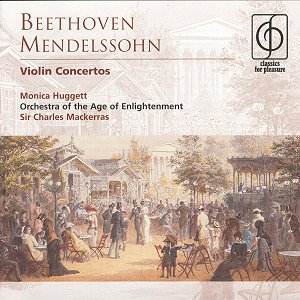
Monica Huggett Plays Beethoven and Mendelssohn
Beethoven: Violin Concerto in D major, Op. 61
Mendelssohn: Violin Concerto in E minor, Op. 64
Monica Huggett, violin
Orchestra of the Age of Enlightenment / Sir Charles Mackerras
Virgin Classics (originally EMI Eminence) CFP 5 74878 2 [66:16]
These period-instrument recordings from 1992—now reissued on Classics for Pleasure—present a curious paradox. Monica Huggett brings impeccable credentials to this repertoire: her work in baroque and classical rendition practice has been influential, even transformative. The Orchestra of the Age of Enlightenment under Charles Mackerras should be dream collaborators. Yet something essential refuses to coalesce.
Begin with the Beethoven. Those opening timpani strokes—they ought to establish cosmic authority, the kind that makes you sit up in your chair. Instead they sound tentative, almost apologetic. The gut strings of the OAE produce a texture that’s lean, yes, historically informed, certainly, but also curiously undernourished. I kept wanting more tonal heft, more of that Olympian grandeur Beethoven surely intended even if he couldn’t have imagined modern orchestral sonorities.
Huggett’s approach privileges clarity over rhetoric. Her sound is lighter than we’ve grown accustomed to from the Heifetzes and Perlmans—no surprise there—but it’s also more reticent than the music demands. The Concerto in D major is, after all, a heroic utterance. Beethoven didn’t write it for drawing-room intimacy. When the solo line enters, Huggett phrases with intelligence and fine technical address, but I miss the kind of interpretive boldness that stamps a performance in memory.
The Larghetto offers compensations. Here Huggett’s restraint serves the music better—there’s genuine poetry in her articulation of Beethoven’s long-breathed phrases, a sense of meditation rather than display. The dialogue between violin and orchestra achieves real intimacy, aided by recording balances that place soloist and ensemble in what feels like authentic spatial relationship. No spotlighting here, no unnatural prominence for the violin. Whether that’s entirely beneficial is another question.
Her cadenzas (her own) maintain stylistic propriety without particular inspiration. They’re tasteful. Sometimes one wants a bit more than taste.—The Mendelssohn presents different problems. That opening melody—one of the most naturally lyrical inventions in the violin literature—needs to breathe and flow like something sung. Huggett’s phrasing feels oddly segmented, as though she’s thinking too hard about period articulation and not enough about the tune’s innate Romanticism. Yes, Mendelssohn was a classicist at heart, but he was also the composer of the Songs Without Words, and this concerto sings throughout.
Or should sing. The "finale" goes better—Huggett’s clean articulation serves the scampering figurework well, and here the OAE’s lighter textures prove advantageous. There’s transparency, buoyancy, a sense of Mendelssohn’s elfin wit. The slow movement, though… that "Andante" wants more warmth than Huggett provides, more of that quality the Germans call Innigkeit. Inwardness. Soul-depth.
Mackerras conducts with his usual professionalism, but even he seems unable to fully ignite this music. The orchestral tuttis lack weight, the string sound thinning out in climaxes where you want richness, even opulence.—I find myself in an awkward position. These are serious musicians making serious choices, and one hesitates to dismiss performances grounded in scholarly research and historical awareness. But period instruments don’t automatically confer validity, and historically informed practice can sometimes sound merely undernourished.
The recordings themselves—made in different London venues—sound decent enough in this remastering, though the Beethoven’s acoustic seems a bit dry for music of such scale. Wadham Sutton’s program notes, retained from the original release, remain distinguished.
For collectors curious about period approaches to these works, the disc offers interest. But as primary recommendations? I can’t quite get there. Both concertos have received performances on modern instruments—and some on period instruments too—that achieve greater interpretive depth without sacrificing stylistic awareness. Huggett’s technical command is never in doubt, but mastery in service of a somewhat pallid conception doesn’t finally satisfy.
The Beethoven in particular needs more. More drama, more risk, more sense that something momentous is transpiring. And the Mendelssohn needs to sing more freely, even if Mendelssohn himself might have conducted it with classical restraint. There’s a difference between restraint and reticence, and these performances too often cross that line.
At budget price, the disc won’t break anyone’s bank. But neither will it become the release you return to when you want to hear these immortal works speak with full voice.