Avison’s Concerti Grossi: An Eighteenth-Century Northumbrian Speaks
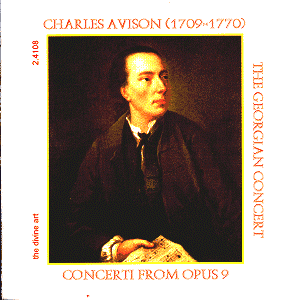
Charles Avison—Newcastle organist, concert organizer, polemicist—remains one of those awkward figures in English musical history who ought to be better known than he is. Born in 1709, he spent most of his professional life at Newcastle Cathedral, and his Essay on Musical Expression (1752) stirred up considerable controversy by daring to rank Marcello above Handel. These concerti grossi from Opus 9, published in 1766, show us why Avison matters: here’s a provincial English performer writing sophisticated chamber music in an Italianate form that was already beginning to sound old-fashioned, yet doing so with considerable intelligence and a distinctly personal voice.
The Georgian Consort—six players, possibly seven, the photograph in the booklet doesn’t quite settle the matter—approach these works with an intimacy that feels both right and slightly problematic. Avison wrote these concerti in four parts rather than the usual seven-part texture of the Italian concerti grossi, which gives them an inherently leaner sound. The keyboard part is fully written out, allowing the works to function as harpsichord solos. It’s chamber music that happens to be called concerti grossi.
And chamber music is exactly what the Georgian Consort delivers. The slow movements are genuinely affecting—that opening "Andante" cantabile in the B-flat Concerto (No. 8) has a singing quality, almost vocal, that these players capture beautifully. The E-minor Concerto’s "Adagio" unfolds with genuine pathos. You can hear the influence of church music here, that particular English restraint that values dignity over display.
But there’s the rub. In the quick movements—and Avison writes plenty of them, often with those insistent dotted rhythms that pervade so much eighteenth-century music—the performances want for bite, for edge, for what one might call athletic vigor. The elegance is there, certainly. The ensemble playing is admirably precise. But where’s the blood? The G-minor Concerto’s opening "Allegro" needs more forward drive, more rhythmic incisiveness. These players seem almost too polite, as if they’re afraid to break the drawing-room atmosphere they’ve so carefully cultivated.
The unusual "finale"s marked “Aria” in three of the concerti present a particular puzzle. Are these Avison’s nod to the expressive theories he championed in his writings? Some influence from the anthem repertoire he knew so well? The Georgian Consort plays them with touching simplicity, letting the melodic lines speak for themselves. It’s effective, though one wonders if there isn’t more rhetorical possibility in these movements than we’re hearing.
Duncan Druce’s presence in the ensemble—assuming he’s not the missing person in the photograph—is reassuring. These are musicians who know this repertoire inside out, who understand the period’s conventions without being enslaved to them. The album quality is distinguished: clear, warm, present without being aggressive. Divine Art has done right by them.
Still, I keep returning to that question of spirit. Avison wasn’t writing salon music for timid amateurs. He was an ambitious, contentious figure who organized subscription concerts and argued publicly about musical values. His concerti deserve performances that honor not just their craftsmanship but their underlying energy and intellectual ambition. The Georgian Consort gives us half of that equation beautifully. The other half—well, it’s present but muted, like hearing someone speak eloquently but without raising their voice above a murmur.
This is valuable work, making accessible music that deserves to be heard. But I’d welcome performances that take more risks, that find the vigor beneath Avison’s provincial English good manners. He was, after all, the man who had the nerve to place Marcello above Handel. That took spirit. His music has it too—if you’re willing to look for it.
Recommended, with reservations.