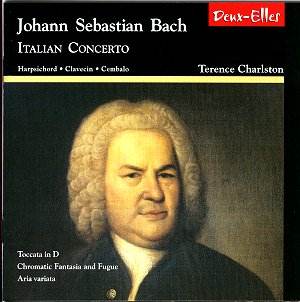
Terence Charlston plays Bach
Italian Concerto and other harpsichord works
Terence Charlston, harpsichord
Deux-Elles DXL 1017 (75:00)
The trouble with Bach recitals—and it’s a good trouble—is that the composer wrote so much magnificent keyboard music that programmers face an embarrassment of riches. The big sets get all the attention: the Goldberg Variations, the two books of the Well-Tempered Clavier, the English and French Suites, the Partitas. But what about the orphans? The pieces that don’t belong to any family?
Terence Charlston has assembled a thoughtful program of these strays and singletons, anchored by the Italian Concerto but ranging from an early set of variations to a lute prelude. The disc runs seventy-five minutes—perhaps ten minutes too long for ideal concentration, though I’m not complaining about the music itself. Charlston plays a copy of a Ruckers instrument built by Andrew Garlick, and the sound is frankly gorgeous. Rich but not muddy, present without being aggressive. Whoever engineered this session understood that a harpsichord needs air around it.
The Aria variata in the Italian manner, BWV 989, opens the recital. This is early Bach—possibly very early, from the Weimar years or even before—and it shows both the young composer’s fascination with Italian models and his still-developing sense of large-scale architecture. Ten variations on a rather plain aria. Charlston doesn’t try to make more of this music than it can bear. He plays with clarity and a certain unaffected grace, varying his registration intelligently without calling attention to his choices. The faster variations have snap; the slower ones breathe. What more do you want?
But then we get to the Italian Concerto, and here I have reservations. This is one of Bach’s supreme keyboard works—published in 1735 as the second part of the Clavier-Übung, paired with the French Overture—and it demands not just technical command but a certain theatrical boldness. The opening "Allegro" wants to swagger a bit, to announce itself. Charlston seems… cautious. His tempo is measured, almost circumspect, and while his articulation is clean, the music doesn’t quite take flight. Perhaps he’s being scrupulous about the dance rhythms embedded in the movement—there’s a courtly quality to his approach—but I found myself wishing for more rhetorical punch.
The slow movement redeems much. Here Charlston’s restraint serves the music beautifully. He shapes the long, ornamented melodic line with genuine feeling, never forcing the emotion but letting it accumulate through the movement’s intricate polyphonic unfolding. The bass line—so crucial in this movement—speaks clearly without dominating. This is playing of real sensitivity.
The "finale" recovers the energy that the first movement lacked. Charlston digs into the "presto" with evident pleasure, and the Garlick harpsichord responds with bright, dancing sonorities. The rhythmic drive is there, the joy is palpable. Why couldn’t he have brought this same vitality to the opening?
Scattered through the program are shorter works that reveal Charlston’s refined musicianship. The Chromatic Fantasy and Fugue—surely not a “lesser known” work, despite the liner notes’ assertion—receives a performance that emphasizes its improvisatory origins without descending into mannerism. The famous opening flourishes sound genuinely spontaneous, not rehearsed into submission. The fugue that follows maintains admirable clarity even in its densest passages.
I was particularly struck by the Prelude in C minor, BWV 999, originally for lute. Charlston uses the lute stop on his instrument—a device that produces a plucked, nasal timbre by pressing a row of leather or felt pads against the strings near the nut—and the effect is mesmerizing. The piece itself is a marvel of gentle melancholy, all those descending chromatic lines, and Charlston plays it with an intimacy that drew me in completely. This is the kind of rendition that makes you hold your breath.
The inclusion of the Aria from the Goldberg Variations—here identified by its source in Anna Magdalena’s notebook rather than by its more famous incarnation—feels like both a tease and a promise. Charlston plays it beautifully, with a simplicity that reminds us how much expression Bach packed into these seemingly straightforward thirty-two bars. One does hope he’ll record the complete variations. On this instrument, with this approach, it could be something special.
The Toccata in D major, BWV 912, which actually opens the disc, is dispatched with considerable flair. These early toccatas—Bach wrote seven of them, probably in his Weimar years—are curious hybrids of North German stylus phantasticus and Italian concerto manner. Charlston navigates the sudden shifts from free fantasia to strict fugue with aplomb, though I wonder if the fugal sections couldn’t have been driven a bit harder.
The recorded sound deserves special mention. Too many harpsichord recordings place the instrument in an acoustic that’s either too dry or too reverberant. This one gets it right—there’s enough space to let the instrument bloom, but not so much that the articulation blurs. Listen on good headphones, as the original reviewer suggests, and you’ll hear the individual strings speaking, the subtle differences in timbre between registers, the satisfying thunk of the jacks returning. This is reference-quality engineering.
So: a mixed verdict, then. Charlston is clearly a gifted player with refined musical instincts and superb taste. The program is intelligent, the instrument is superb, the sound is first-rate. But the Italian Concerto—the marquee work on this disc—doesn’t quite catch fire, and that’s a considerable disappointment. The rest of the recital offers much to admire and enjoy. Worth hearing, certainly. Essential? Perhaps not.