# Adolf Busch in America: The Radiant Integrity of an Exile
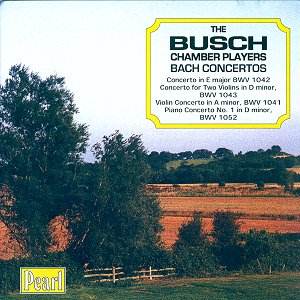
BACH: Violin Concertos BWV 1041, 1042; Double Concerto BWV 1043; Keyboard Concerto BWV 1052
Adolf Busch (violin and director); Frances Magnes (violin); Eugene Istomin (piano); Busch Chamber Players
Pearl GEMM CD 9298 (recorded New York, 1942–1945) [72:47]
What a strange, luminous document this is—and what a mess Pearl has made of it.
These wartime New York recordings capture Adolf Busch at a fascinating juncture: the great German violinist in exile, his pre-war European reputation secure but his American presence somehow never quite consolidated in the public imagination. Perhaps the Toscanini glamour eclipsed him. Perhaps American ears, already intoxicated by Heifetz’s streamlined brilliance, found Busch’s more ruminative approach too Germanic, too weighted with thought. Whatever the reason, these performances—now nearly eighty years old—arrive with the force of rediscovery.
The E major Concerto reveals Busch’s aesthetic immediately. Those heavy bass accents won’t please everyone; the acoustic is resonant to the point of occasional overload, with a tubby bottom end that suggests Town Hall or one of those capacious New York studios where the engineers hadn’t quite mastered the new electrical technology’s capacity for capturing low frequencies. But listen past the sonic limitations. At 5:04 in the first movement, Busch shapes a phrase with such expressive heightening—a slight lingering on the apex of the line, then a gentle relaxation—that you understand immediately what musicianship meant before the age of metronomic precision. And in the slow movement, remarkably, he avoids those Brucknerian luftpausen that mar so many period performances, the ones where violinists of Busch’s generation would insert great gulping pauses between phrases as if the music needed artificial respiration. The "Adagio" emerges with its architectural integrity intact, a continuous meditation rather than a series of aphoristic utterances.
His slides here are precise, appositely tasteful—never the sticky portamentos of Kreisler or Elman, but deliberate expressive gestures that connect rather than separate. Artur Balsam provides continuo, though he’s mixed so distantly you’d think Busch wanted the harpsichord merely glimpsed rather than heard. (The same peculiar balance afflicts Mieczysław Horszowski in those Handel Concerti Grossi recordings—I assume Busch preferred his accompanists felt rather than foregrounded.)
The Double Concerto, recorded in 1945, faced formidable competition even then. Memories of Szigeti and Flesch, of Menuhin with Enescu, of the Rose recordings—these hung in the air. But Busch and Frances Magnes (a name now vanished from the reference books, alas) make a genuinely congenial partnership. This is romanticized Bach, no question—the "Largo" becomes an aria of profound subordination, Magnes deferring to Busch’s long-breathed phrasing with real sympathy. Only those thunderous bass accents in the "finale" give me pause; they’re obtrusive, almost willfully so, as if someone felt Bach needed underlining.
Then comes the A minor Concerto, preserved live from a 1943 Town Hall concert on acetates that Busch’s widow somehow saved from oblivion. The sound is constricted, yes—at moments positively desiccated—but the flexibility of Busch’s line is uncanny. He’ll stretch a phrase just beyond what you expect, then compensate with a quickening elsewhere, maintaining an overall architecture that feels both spontaneous and deeply considered. There are a few thumps on the acetates. There are moments where the tone thins to near-brittleness. The tempo relationships in the outer movements strike me as slightly stodgy, though I hesitate before that judgment—perhaps what sounds earthbound now felt properly weighted then. Lukas Foss provides continuo here, audibly so, supporting Busch’s devoted phrasing with more presence than poor Balsam enjoyed.
Eugene Istomin’s D minor Keyboard Concerto is robust, forthright, youthfully confident. The trills are even, the passagework splendid, the technical security never in doubt. But it’s not quite deep enough—there’s a certain firm-jawed determination that substitutes energy for insight. Istomin would become a great performer, of course, but this early interpretation, for all its accomplishment, remains on the surface of Bach’s extraordinary invention.
Now to the scandal. Pearl has sequenced this disc with barely a second’s gap between movements. Unbelievable. Did no one listen before pressing? The E major Concerto’s sublime "Adagio" crashes into the "finale" without pause for breath. The Double Concerto’s movements collide like railway cars. This isn’t an aesthetic choice; it’s simple incompetence, and it mars what should be a crucial reissue of historical performances that illuminate an entire approach to Bach—an approach now vanished, for better and worse, from our streamlined modern practice.
As a matter of urgency, Pearl should repress this disc with proper spacing. The performances deserve nothing less. Busch’s American years remain inadequately documented; these recordings, with all their sonic limitations and period mannerisms, reveal a musician of radiant integrity, someone who understood that Bach’s architecture could accommodate both intellectual rigor and expressive warmth. Fix the sequencing, and this becomes an essential document. As it stands, it’s a flawed glimpse of greatness—maddening because the remedy is so simple.
Recommended, with serious reservations about presentation