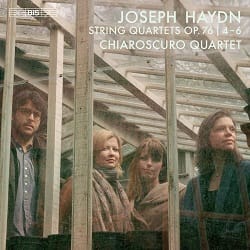
Franz Joseph HAYDN (1732-1809)
String Quartets op. 76
Quartet No. 4 in B flat major “Sunrise” [21:14]
Quartet No. 5 in D major [16:24]
Quartet No. 6 in E flat major [20:58]
Chiaroscuro Quartet
Rec. January 2018, Reitstadel, Neumarkt, Germany
BIS BIS2358 SACD [59:34]
The Chiaroscuro Quartet’s completion of Haydn’s Op. 76 set arrives three years after the disc sessions—an inexplicable delay from BIS, though one hardly matters now that we have these performances in hand. And what performances they are.
I confess to having been skeptical about period instruments in chamber music. The gut strings, the absence of vibrato, the leaner sound—all this seemed to me, for years, more archaeology than art. The Chiaroscuro has changed my mind entirely, and with these late Haydn quartets they’ve done something more remarkable still: they’ve made familiar music sound newly minted without sacrificing an ounce of its warmth or wit.
Take the opening of the “Sunrise” Quartet. The Chiaroscuros begin at barely a whisper—so soft that you lean forward instinctively. The volume grows with glacial patience, each player’s entrance timed with almost theatrical precision. When the Allegro con spirito finally erupts at bar 22, the effect is genuinely startling. I measured the introduction against the Kodály Quartet’s version (yes, I actually did this): the Chiaroscuros take a mere four seconds longer. Four seconds! Yet the impression is of something far more expansive, more dramatically conceived. The explanation lies in dynamics. Using audio software, I found the Chiaroscuros nearly double their volume at the transition point, while the Kodálys actually grow slightly quieter. Which approach better serves Haydn’s sunrise metaphor hardly needs stating.
This attention to dynamic shading permeates all three quartets. In the D major’s Largo, the first violin’s melodic line emerges from the texture with a fragility that modern instruments, for all their tonal beauty, rarely achieve. The gut strings give each note a kind of vulnerable presence—you hear not just pitch and duration but the physical act of bow meeting string. When Alina Ibragimova shapes that opening phrase, there’s a slight unevenness to the sound, a human quality that feels utterly right for music written when technical perfection was less prized than expressive immediacy.
The E-flat Quartet benefits most from the Chiaroscuro’s approach. Its opening Allegro can sound almost too civilized in modern-instrument performances; here it has genuine bite. The sforzandi land with real force—not violent, but emphatic in ways that remind you Haydn was writing for aristocratic patrons who expected entertainment along with edification. The famous Fantasia slow movement, marked Adagio, unfolds with the kind of structural clarity that only comes from players who’ve thought deeply about harmonic progression. Each modulation registers as an event, not merely a passing moment.
I keep returning to the cello part throughout these performances. Emilie Hörnlund plays with such rhythmic vitality, such independence from the ensemble’s collective pulse, that you’re constantly aware of Haydn’s four-part democracy. Modern cellos, with their greater projection, can paradoxically disappear into the texture; gut strings and period setup give Hörnlund’s instrument a woody, tactile presence that sits perfectly in the sonic picture. Listen to her pizzicato work in the D major’s Menuetto—it’s not background accompaniment but commentary, almost cheeky in its assertiveness.
The recorded sound from the Reitstadel in Neumarkt deserves mention. BIS has captured the ensemble in what sounds like ideal acoustic space: enough resonance to blend the instruments naturally, enough clarity to hear each voice distinctly. I listened to the 16-bit download; I can only imagine the SACD surround sound places you in the hall itself. The balance favors no one instrument, and the dynamic range—crucial for these performances—is captured without compression or artificial enhancement.
My comparison has been primarily with the Kodály Quartet, whose Naxos cycle established them as serious Haydn interpreters. They remain a fine ensemble, but next to the Chiaroscuros they sound polite, even cautious. Where the Kodálys smooth over Haydn’s rough edges, the Chiaroscuros embrace them. Where the Kodálys seek tonal blend, the Chiaroscuros let each instrument speak its own dialect. It’s not a matter of one approach being right and the other wrong—but the Chiaroscuro performances feel more alive, more risky, more willing to treat Haydn as a composer who still has things to tell us.
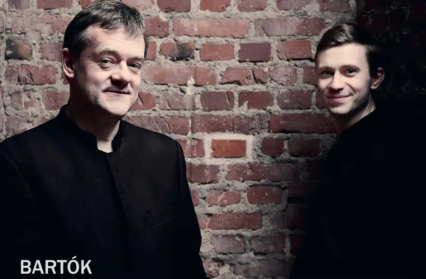
Richard Wigmore’s booklet notes are, as expected, models of scholarly clarity and musical insight. The Chiaroscuro Quartet, formed in 2005 (they look impossibly young in their photographs), has now given us six releases on BIS, each one redefining our expectations for Classical and early Romantic chamber music. Their recent Beethoven Op. 18 set earned Recording of the Year honors from multiple critics; on this evidence, this Haydn deserves similar recognition.
The complete Op. 76 set—this disc and its predecessor containing Nos. 1–3—now stands as the version to own. The Chiaroscuros have that rarest of qualities: they make you hear music you thought you knew as if for the first time, not through willful eccentricity but through profound understanding of style and structure. Haydn sounds both rustic and sophisticated here, earthy and refined, serious and playful—often within the same phrase. Which is, of course, exactly what he is.