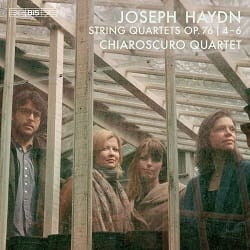
HAYDN String Quartets, Op. 76, Nos. 4–6
Chiaroscuro Quartet
BIS BIS2358 SACD [59:34]
The Chiaroscuro Quartet’s completion of Haydn’s Op.
76 set arrives with the kind of sonic clarity that makes you wonder why anyone bothered with steel strings in the first place. These three quartets—the “Sunrise,” the D major, and the E-flat—receive performances so alive with textural detail and rhythmic spring that my long-held affection for the Kodály Quartet’s traversal now seems like devotion to a comfortable but slightly faded photograph. I’ll confess: gut strings and period instruments once struck me as an acquired taste best left to the zealots.
The Chiaroscuros have made a convert of me, though not through evangelism but through sheer musical intelligence. Take the opening of the B-flat Quartet. That famous sunrise doesn’t merely glow—it smolders, beginning at what feels like the threshold of audibility.
The first violin’s ascent emerges from near-silence with such deliberate patience that when the "Allegro" con spirito erupts at bar 22, the effect is genuinely startling. I measured the introduction against the Kodálys: a mere four seconds slower — yet the Chiaroscuros create the illusion of far greater temporal expansion through dynamic shaping alone. Where the Kodálys maintain relatively even volume across the transition, the Chiaroscuros nearly; double their intensity—the difference between dawn breaking and someone throwing open the shutters.
This isn’t interpretive gimmickry. It’s Haydn’s architecture made audible. The absence of vibrato—initially unsettling to ears trained on Romantic largesse—allows each voice its own distinct character.
The cello, especially, emerges as a genuine interlocutor rather than a genial foundation-layer. In the D major Quartet’s "Largo", the four instruments converse with a transparency that reveals contrapuntal details I’d somehow missed in two decades of listening to this music. The gut strings produce a sound simultaneously earthy and ethereal, with a slight edge that gives forte passages real bite without harshness.
Tempi throughout favor extremes. Fast movements press forward with exhilarating momentum—the "finale" of the E-flat Quartet nearly gallops—while slow movements luxuriate in spaciousness without ever turning soporific. The Fantasia of the “Sunrise” unfolds with improvisatory freedom, its harmonic digressions sounding genuinely unsettling rather than merely eccentric.
This is Haydn the innovator, not Haydn the genial Papa. The recorded sound, captured in Neumarkt’s Reitstadel, places you close enough to hear rosin on horsehair, distant enough to appreciate the hall’s warm acoustic. BIS’s engineers have provided ideal balance—no instrument dominates, yet soloistic passages emerge with natural prominence.
That particular brightness of period instruments catches the ear.
The 16-bit download I auditioned (the SACD layer presumably offers even greater spatial definition) conveyed remarkable presence. Richard Wigmore’s notes provide the historical and analytical context one expects from this writer, — though honestly, the performances themselves constitute the most persuasive advocacy these works could receive. The Chiaroscuros—formed in 2005, which seems improbably recent given their collective maturity—have developed an interpretive approach that makes period realization sound less like scholarly reconstruction than like the only sensible way to play this music.
I’ve lived with the Kodály Quartet’s Op. 76 since the early Naxos days, valuing its polish and — well — affection. The Chiaroscuros don’t so much replace it as reveal what I’d been missing: the radical edge in Haydn’s — late style, the conversational urgency, the sheer physical pleasure of four skilled musicians thinking and breathing as one….
Their earlier Op. 20 set prepared me for this, but these performances surpass even that achievement. The only frustration is that BIS took three years to release these 2018 sessions.
Better late than absent entirely—this stands among the finest Haydn quartet recordings currently available, period instruments or otherwise. If you’ve been skeptical about gut strings and — well — historically informed performance, start here. The Chiaroscuros have redefined what these quartets can reveal.